Note: This post was written on March 7 but will be posted on a future day when I have a stable internet connection.
Today was a long day, so this will likely be a short post. We climbed over a high pass, Lamjura La, which is the highest we will be for several days. At 3500 m elevation (about 11,500 ft) the climate there is decidedly cooler. Small patches of what looked like relatively fresh snow flanked the trail. We arrived at a small tea house for lunch just below the pass at 11:00 am and with the sun, the temperature was quite comfortable. As we ate our lunch, clouds began building and the wind blowing. By the time we crossed the pass, the clouds had obscured the sun, and a stiff wind made it feel quite cold.
11,500 feet high but in the foothills. Lamjura Pass is in the distance.Your hero at Lamjura La.
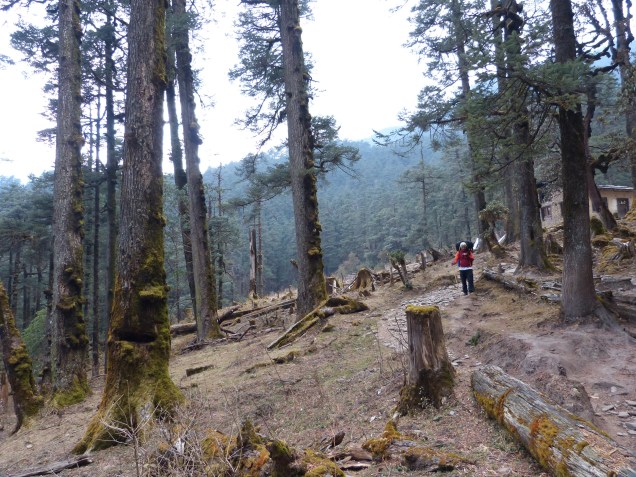
The descent down to the village of Junbesi was an endless slog down a deep valley. The start of our descent passed through a mossy, magical forest of pine and rhododendron. Farther down as we approached the Junbesi river, I was surprised to see road-building activity once again. This road came up the river from the south. Our trek is essentially a eastward march directly across the topographic grain defined by the southward flowing rivers draining the high Himalayas. Hence our route is 90 degrees to the topography and therefore intensely up and down. However, in the aftermath of the 2015 earthquake, the road-building frenzy utilized the north-south valleys to access these rural areas hardest-hit by the earthquake.
It was a long slog down from the pass, but through some nice forest. Gokul, my porter, is for scale.
As we approached Junbesi from above, we could see the new road, passable but still under construction. Junbesi also had power from a generator downstream. The town is much more prosperous than the small villages along the ridge lines. Our accommodation for the evening, the Ang Chokpa lodge, was a very pleasant surprise. I got a large room with an attached bath AND hot water in the shower. I was even able to access a reasonable town-wide WiFi for about $5, although it went down before I could post this. I’m writing this sitting around the wood burning stove in the toasty common room while digesting my spaghetti dinner (a nice change from dal bhat). Tomorrow looks like a relatively easy flat day on the map, but I have learned that Nepali flat means up down up down up down….
I feel lucky to be alive tonight. I have survived the most dangerous part of my trek, the 200 km drive to Jiri. But let’s start at the beginning…
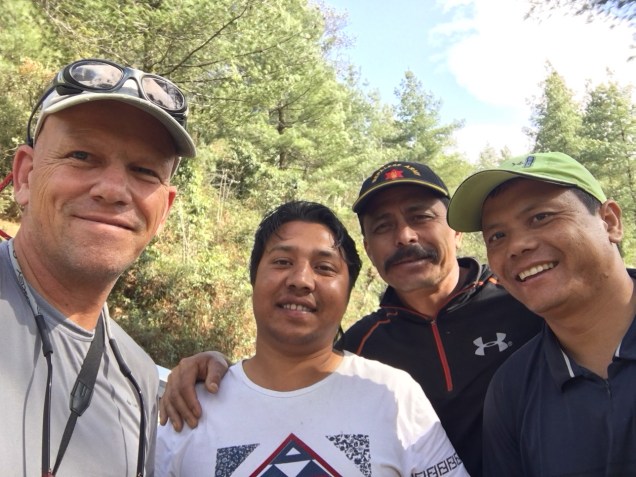
My guide, Bahkta and my porter, Gokul (who is a slightly darker version of the Marlboro man), met me at my hotel at 8:00. We also had a driver who I am pretty sure is in training for the Indianapolis 500.
From the left, me, Mario Andretti, the Marlboro man, and Bhakti
Our car was a small Toyota sedan, and we all clambered in and headed out into Kathmandu’s traffic. I asked to sit shotgun, and man, was that a good choice! Bahkta and Gokul stuffed themselves in the back. The first hour was spent getting out of Kathmandu. On the outskirts of town we passed mile after mile of brick factories; the Nepalese were busily creating the tools for their own demise during the next big earthquake. The traffic was stop and go, mostly stop. Finally we emerged onto the the Aranko Highway, a route built by the Chinese in the 1960s that connects Kathmandu to the Tibetan border. After a couple of hours we branched off onto the B.P. highway, a new road built by the Japanese that connect Kathmandu to the southern lowlands.
Let me describe these roads: hair raising (if I had any), vomit inducing, ass-puckering and pee loosening doesn’t begin to do this route justice. Nominally 2 lanes, in reality it would be a generous bike lane in the US. Often, when a truck and a bus pass, both vehicles would slow to a crawl, and inch past each other with mm to spare, horns a-honking the entire time. The road climbed and fell, often with shear drop-offs. Guardrails? Who needs ’em! My driver drove like he was late for his wedding (more likely his funeral). With incredible skill he passed all manner of slower vehicles with inches to spare between us and oblivion. And all this describes the first half of our route.
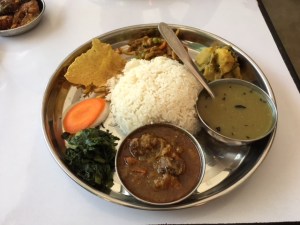
About halfway, we made a quick stop for lunch – delicious dal bhat and curry.
A delicious lunch, Dal baht, the 24 hour fuel
Fear makes the best spice. After lunch, the route crossed a bridge and followed the Tampa Koshi River to the north. The road was now an ancient, nominally paved, single lane trail, pot-holed and washed out by floods over long sections. The road demanded 20-30 km per hour, my driver insisted on 50+ km per hour. Any on coming traffic was negotiated via a game of chicken; we won more than lost. The road then left the river and climbed, and climbed and climbed. Finally, we reached Jiri at 3:30 pm, for a 7 hour 30 minute time – probably my driver broke his own world-record. Jiri turns out to be a rather dismal village at the end of the road. Main Street is a wide but rough dirt road. We checked into a small Sherpa guest house. I bought my crew a beer, and we had another meal of dal bhat. I feeling at once excited and apprehensive about the coming trek. Tomorrow it begins.
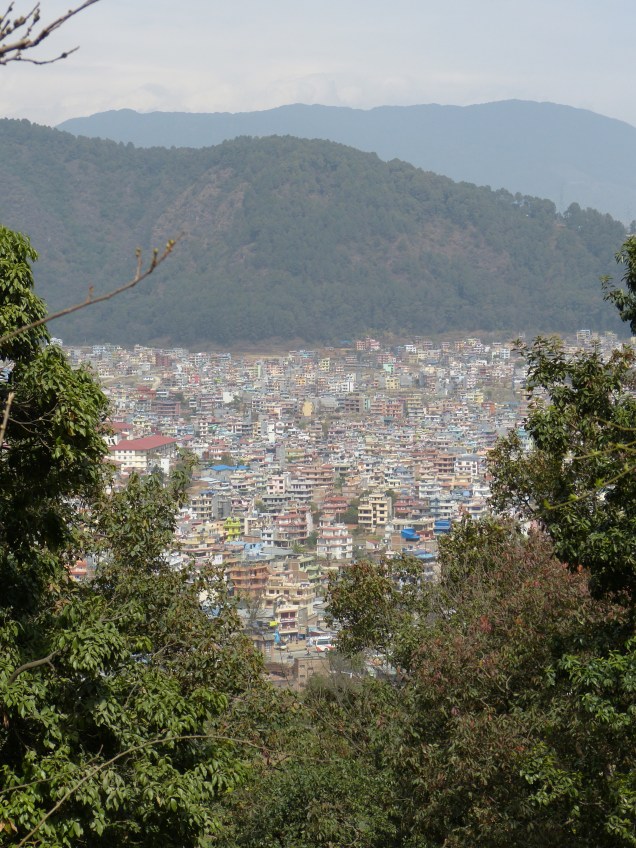
When I last visited in 1986, Kathmandu had a population of 400,000, today this exploding city is now an order of magnitude larger with over 4 million inhabitants. Today I toured some of the famous landmarks of the city with a driver and guide. Dubar square, a couple of famous temples, and a cremation site along the river.
View of Kathmandu from Swayambhunath Temple
None of this impressed me much, but what did was the incredibly lasting impact from the earthquake that struck Nepal nearly 3 years ago. Over 9,000 people perished in that temblor, but it could have been far, far worse. The earthquake struck at noon on a Saturday which is Nepal’s Sunday. Schools were closed, children were out playing in the streets and parks, and businesses were shuttered. But the property lose was unbelievable. My driver said that in his village only a single house was left standing and that house became a field trip stop for building engineers. Bricks are everywhere. Piles of recycled brick, neat stack of new bricks, and many piles of broken bricks that no one has yet bothered to haul away. Construction is everywhere, yet still has so so far to go. Dust. Oh the dust. A perpetual yellow haze hangs over the city and coats everything left outside. In spite of all this, the tourist district is bustling again; Nepal is open for business.
Scenes from a shaken city
The drive today also reminded me how aching poor Nepalis are. The homeless are everywhere and by comparison the cardboard shacks inhabited by SoCal’s homeless seem like palaces. My tour guide said that over the last 10-20 years, there has been a mass migration from rural Nepal to the city where hopes for a brighter future collided with the harsh reality. Yet in the face of hardship, the Nepalis remain upbeat. My tour guide talked proudly of how Nepal is now a democracy after years of incompetent governance in a country run by kings.
I spent the late afternoon completing my supply shopping, and having a last beer and pizza in relative civilization. Tomorrow morning I will be drive about 185 km (8 hours!) on the Araniko Highway, arguably the most dangerous section of road in the world. I checked it out on Google maps and all I can say is that I hope I can ride shotgun.
After 32 years, I have finally returned to Kathmandu. I left Bangkok about 11 am after stuffing myself with 3 Krispy Kreme donuts and a cup of Starbucks (my waistline hopes they never open a KK franchise in Chiang Mai, the rest of me does). My flight was delayed by about an hour as we entered a holding pattern south of the city, then waited another 30 minutes on a taxiway while waiting for a parking spot. Although my memory has faded, it seems that not much has changed at Tribhuvan International Airport, it is still tiny and rather chaotically ad hoc. The trekking company I booked with had a driver dutifully awaiting my late arrival, and we drove slowly through the dusty, dusty streets, lined by piles of debris and bricks seemingly still leftover from the Earthquake 3 years ago. I arrived at the small botiqueish Dom Himalaya hotel in about 30 minutes. I was warned to tell the front desk 5 minutes before I showered so that the could turn on the hot water. Yes, I’m back in the third world.
With the remainder of the day free, my first step was to find an ATM. Here’s where my adventure began. My transaction went normally until the screen said “take your cash”, then it flashed “transaction cancelled”. My card reappeared, but before I could grab it, the machine slurped it right back inside. Then the screen reset to “please insert your card”. I could almost see that damn machine smile at me for offering such a tasty morsel. To make matters worse, I got an email from my bank in the US notifying me that I had just withdrawn 35,000 rupees or about $340. So now I am standing there with no rupees, no ATM card, and the bank had just closed 15 minutes prior. I was forced to dip into my emergency dollar cash reserve, which I was able to change into rupees at a nearby money changer. I guess I’ll be waiting at the bank door at 10 am tomorrow morning.
I spent the rest of the afternoon and evening getting a local SIM card, and picking up some odds and ends for my trek. Kathmandu is very different than I remember it. Back in 1986, the streets of the city had more sacred cows than cars. Now the cows have apparently been banished to be replaced by a cacophony of sacred cars and motorcycles. One nice thing though, the main part of the Thames area is a maze of walking streets, no cars. That made for a very pleasant shopping stroll amongst the myriad of small shops selling trekking gear. I finished the evening with a fine meal of Indian food at the Third Eye Restaurant.
A romantic candlelight dinner for one in Kathmandu.
Almost to the date, 32 years ago, I set out on a 3+ week trek around Annapurna, in the Himalayas Mountains of Nepal. Next week, I will return to Nepal to begin a 3+ week trek to Everest Base Camp, with a side trip to Gokyo Lakes. To make this new trek even more fun, I will begin my walk from Jiri instead of flying into Lukla. This will add an additional week to the trek as I hike the original approach to Namche Bazaar, the gateway to the Everest region.
During that first trek so long ago, I trained by lying in the sun, drinking beer, and otherwise cavorting around Thailand for three weeks before arriving in Kathmandu. My now 62 year old lungs and legs would have little chance in Nepal if I followed the same training regime this time around. So, for the last few weeks, I have been hiking the jungle trails up and down Chiang Mai’s Doi Suthep – Doi Pui Mountain.
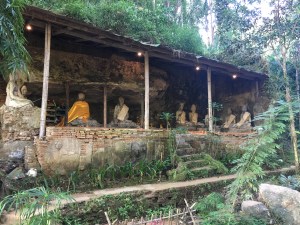
From Chiang Mai city, Doi Suthep Mountain appears as a large completely forested hulk, with the famous Doi Suthep Temple perched on a promontory about 2000 feet up. The temple is serviced by a well-travelled, paved road plied by fleets of buses, fans, and songtaews that ferries 1000’s of tourists up to the temple every day. Only a handful of people take the direct route, up the walking trail. The first part of the trail, known as the monk’s trail, begins at the mountain’s base, and proceeds up to a lesser known temple, Wat Pha Lat, perched about 700 ft above the trailhead.
A trail-side shrine at Wat Pha Lat
From there, the “trail” makes a direct beeline for Doi Suthep temple sans switchbacks. This being the dry season in Thailand, the trail consists of a series of steps stomped into the hard clayey soil. During the rainy season, I imagine that the trail would make a great muddy waterslide; temple to trailhead to hospital in 5 minutes!
I have now been up and down this trail many times – I know every root and rock along the way – I’m pretty sure I could navigate the trail blindfolded.
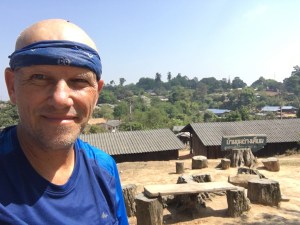
Yesterday, as an alternative, I chose a very lightly used trail that diagonals up the mountain toward the northwest to the small hill-tribe village of Ban Khun Chang Kian (บ้านขุนช่างเคี่ยน) a small settlement spilled across a high ridge about 3000 ft above the City.
Your grizzled hero at Ban Khun Chang Kian
The trail is mostly used by mountain bikers who get hauled up the mountain in the back of pick-up trucks, and then come tearing down the trail, hikers beware. I also saw a couple of crazy farang trail runners – not many hikers though, mostly the trail is empty and quiet.
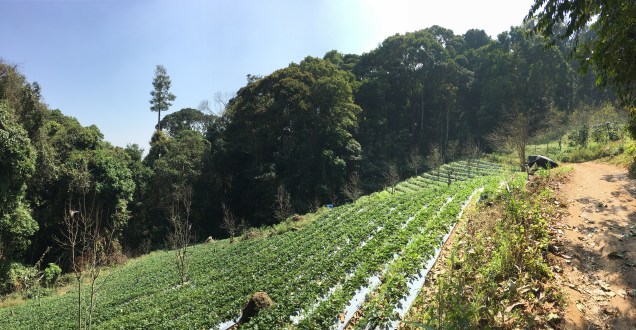
From the village, I traversed about 9 km south to Doi Suthep temple, following a four-wheel drive road that led eventually to a poorly maintained trail. The first part of the traverse passed by numerous strawberry fields that thrive in the cooler mountain-top environment. Trail finding was a bit of a challenge – the jungle hides a spider’s web of jeep trails and walking paths going every-which-way. After climbing over what seems like 100s of fallen trees, I arrived at the bustle of Doi Suthep and descended the steep trail to just above Wat Pha Lat, where I finished the 20 km long hike with a 3 km traverse back to my parking spot along the Doi Suthep road.
Terraced strawberry fields forever
Hiking this trail gave me a great workout – the distance and elevation gain probably equals or exceeds any day-long segment I will encounter in Nepal (albeit at low altitude). The trails are pleasant enough, although quite steep in places. During the dry relatively cool season (temps in the upper 80s- low 90s F) the cooler temperatures up high are pleasant. There were only two real downsides to this hike. One was the constant cloud of kamikaze gnats that enveloped my head. These terrorists had a penchant for exploring any orifice of mine they could find, and apparently they thought my eyes were portals to a bug’s paradise. I spent much of the hike wondering if the swarm consisted of the same 200 bugs who found me at the trailhead and followed me for 20 km, or whether they were a tag-team outfit that each had their own designated section of trail. I imagined attaching a nano GPS transmitter to a few of the gnats to answer this question. Such are the thoughts that occupy my feeble brain when my legs and lungs are on autopilot.
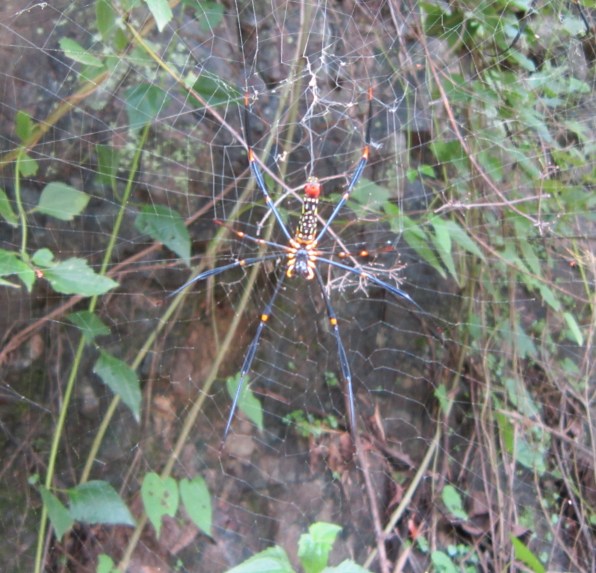
The second downside was the 20-30 inevitable spider-web-face-plants. A face-first meeting with this guy will get your attention!
I am hopeful that these forays into the Thai jungle will amply prepare me for the hiking in Nepal. My next post will likely be next week from Nepal….
Why did I choose to retire here in Thailand? This is a question I am asked often by my American friends – especially those who think I actually live in Taiwan. Of course there are very many reasons; my decision to retire here was not taken lightly and took many years to formulate. But the story of my day today serves as a great illustration of why I retired half-way around the world from where I lived for 59 1/2 years.
Actually, the story of today began yesterday morning. As I was eating my green curry and rice for breakfast I had that familiar feeling of a foreign object in my mouth….a crown that covered an upper molar had dropped off into my soup (yeah it has happened before). I fished it out and placed into a baggy, finished by breakfast, then called the dental clinic at Bangkok Hospital (Chiang Mai branch).
Bangkok hospital is the nicest hospital I have ever been in – far better than any I have been in in the USA. The ambiance is that of a five star hotel. You are treated as an honored guest and the facilities (as far as I can tell) are world class. My call yesterday morning was answered promptly and in perfect English. They wanted me to come in straight away, but I opted for the next day (today). I wasn’t going to let a missing molar mess with my regular Thursday golf outing.
Back to today…I arrived at the appointed time at the hospital and entered their large parking lot where a uniformed attended directed me to an open spot. As he guided me in, he noticed that my tire looked flat. He looked closer and noticed the bolt that I had picked up that was slowly but surely releasing the tire’s air. Shit… when things start going wrong you wonder where it will stop. I didn’t wonder long though, the attended said not to worry, he would see to it that my tire was changed while I was in seeing the dentist.
Up I went to the 4th floor dental clinic where I had to wait about 90 seconds before being ushered into the examination room. I ask my American friends: whens the last time you waited for only 90 seconds in and doctor’s office? The dentist happened to be the same as had just cleaned my teeth a few days before. She took one look and said “no problem”. Within 15 minutes my crown was glued back in place. I had to wait another 5 minutes while they tallied up the bill – the princely some of 1070 baht – about $34 US. My Thai friends would be shocked at this extravagant price – the same service might be half this much elsewhere. Such is the cost of luxury here.
When I returned to my car, the flat had been changed and the attendant rushed over to give me my keys. I asked “how much”, and he shook is head and waived his hands. I tried to force a tip on him, but he ran off saying helping me was part of the hospital security service. No need for AAA here. I still need to fix my tire because I only had a donut spare – fortunately there was a “Cockpit” tire store 200 m down the road. It took them 10 minutes to fix the flat with a plug and change out the spare. My cost? 120 baht or $3.80.
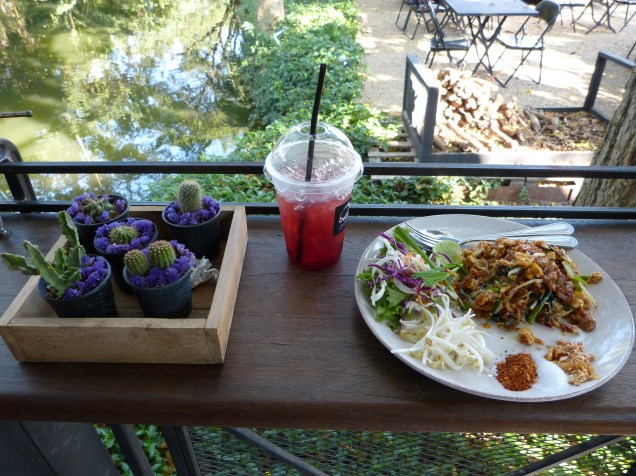
Thirty minutes later I was having lunch with my SO at small cafe – we like to try new restaurants whenever we can.
Pad Thai at Ombra the Garden
I awoke that day in dread of having to get a new crown (or worse) and having to spend a couple of hours in the dentist chair and the rest of the day with a numbed face. My dread increased when I saw the flat tire. What next? But the Thai’s have a wonderful way of making life easy. Days like this (i.e. most days) make me happy about my retirement choice.
I have now been back home 5 days already, and it seems like forever. It seems like I never left. While I was on the ride, it seemed like the never-ending-tour. It seemed like I had been riding my whole life, and still had a long way to go. While on the tour, life became very simple. Eat, ride, eat, drink, check-in hotel, write, eat, ride, etc. etc. I had no appointments to keep, no problems to solve, no one to worry about but myself, and no deadlines other than the setting sun. On my return, I awoke to dead batteries in my car and iPhone, and spent the day replacing both. I now have appointments to keep, golf tee times to wake up for (I know, I have a tough life), and the everyday nuisances of normal life. A part of me misses the simplicity of the road (but not the sweat).
A misty early morning near Fang – one of the many memorably scenes along my route.
Would I do this trip again. The short answer is no, but I would do a trip similar to this in a new place. Would I recommend this trip to others. Yes, if they were prepared to cycle in the relative heat, adapt to the culture of the Thai roads, and wanted a prolonged experience of Thai culture. Here are some final thoughts that I hope will be of use to anyone considering a trip like this one:
I chose the perfect time of year to go. November is relatively cool (nothing over 90 F), with relatively low humidity. I had one 60 minute rainstorm, the rest of the trip was dry with mostly sunny skies. Winds are light enough to me a non-issue. Hotels were empty as were many of the roads. Any other time of year would have meant dealing with higher or lower temperatures, abundant rain, and/or intense heat. The forests were still green from the rain season, and it was harvest time for the rice, but they had not yet started to burn the fields (which will turn the air foul by February or March). This tour is certainly doable any time of year November is nearly ideal.
I had the perfect bike for this ride. The Marin Gestalt 2 is moderately priced, relatively rugged (without being heavy), and easy to fix and maintain. I am sure better bikes are out there, but probably not for the price. I added a rack, kick-stand (an absolute necessity!), and fenders which helped keep me and the bike clean. I do admit though, that an even lower “grandpa gear” would have been nice.
I travelled light. No rain gear – I figured I would be wet from sweat anyway, and in November, if it is cold, it will usually be sunny. I carried only a couple of changes of clothing, and was able to do laundry along the way (although this will usually mean a rest day because clothes must be line-dried). I carried only a small cache of emergency snacks – food was easy to find almost everywhere. I stayed in hotels, so no camping gear was needed. Bottled water is everywhere and cheap.
If I could re-plan this trip, I would avoid the heavily travelled road between Lampang and Chiang Mai, and perhaps take a quieter route from Phrae to Lampang, or skipped that area altogether. The rest of the route was on lovely quiet roads with only short sections (near towns) of heavy traffic. I would have like more time spent cycling along the Mekong – this was the most memorable part of the trip.
I had a Cat’s Eye wireless odometer that I can only give a mixed review. It on occasion just quit working – most likely because the sensor – pick-up gap was too large. Unfortunately the design of the Gestalt’s front forks made adjusting this gap difficult to impossible. The real winner was the iPhone mount teamed with the Cyclometer Elite app for OSX. It gave me all the stats I needed with a very easily read display. The only downside was the large battery drain on my iPhone, but the back-up battery in my iPhone case more than compensated.
This and my soon-to-come “by the numbers” post will be my last post specifically about this tour. If anyone is thinking about a ride like this, I am happy to answer your questions. Reach me at bprhodes@mac.com. I do not no where this Blog will go from here. I am sure I will find something to say. Stay tuned!
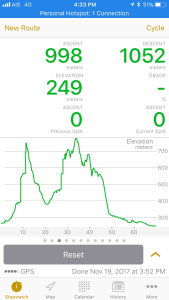
Wow, that was a lot harder than I thought! My plan for the day called for a ride of just 68 km, by far my shortest ride of the entire tour. What I did not realize at the planning stage, was that this route climbed over two mountain ridges and numerous other smaller ups and downs, resulting in a total of 998 vertical meters – doubling the climb of my next hardest day. The result is that today actually felt like my toughest day, rather than what I though would be my easiest day. Even though I got an early start of 7:45, I still arrived in late afternoon. But I made it! By reaching Nan, I have reached the ultimate goal of this tour. For me, Nan has always had the aura of an isolated and remote province. I initially though I would drive here. But when knee surgery last year forced my to quit running, I bought a bike, started cycling around Chiang Mai, then decided to cycle to Nan. My plans became increasing ambitious, resulting in this tour. I feel like the mountaineer who has reached a long sought summit: bone-tired, a little let down, and apprehensive about the decent – in my case the ride from here back to Chiang Mai. More on that below.
The ride out of the very quiet Chiang Muan valley began almost immediately, climbing to the first ridge in just over 12 kilometers. Just after reaching the crest of the ridge the road plummeted down to the The Baan Luang Valley. There I paused for a late morning cup of coffee, and stocked up on my water supply.
Dense jungle covered the high ridge northwest of Nan.
A panorama from the first high ridge east of Chiang Muan.
This sign at the small parking area on top of the highest ridge says no drugs, alcohol, and keep quiet. One wonders how many Chiang Muanians were conceived under the stars here.
A pretty good cup of Americano in Baan Luang
Just over half way to Nan from Chiang Muan, and I was knackered!
Then up I went again, this time very steeply, over a ridge covered in lush jungle. When I finally reached the ridge crest, it was mid-afternoon already, and quite hot. The way down to Nan from there was a series of roller-coaster hills where You go up 10 meters for every 15 You lose. To make matters a little more interesting, one of the steepest downhill sections was being reconstructed and I had to inch down through the mud made by a dust mitigating water truck. The mud caked between my tires and fenders bringing my rear wheel to a wheezing stop. Another 30 minutes was spend scrapping out the gooey mud so that my tire would spin again.
I finally arrived in Nan about 3:30 pm, some 3 hours later than expected. After checking in to the Baan Nan Hotel, I brought my bike to the Nan Cycling shop, and left it for them to clean up, and adjust the gears. They did a great job for only 250 baht.
Nan Cycling – highly recommended!
My after dinner snack in Nan.
I don’t have much to say about Nan. The idea of the place far surpassed the reality. Nui, the proprietor of Nan Cycling, was hard pressed to think of anything to see in Nan besides one museum and some temples. Perhaps interesting sites lie outside of town, but those will have to wait until I come back in a car.
Every mountaineer, when he or she reaches the summit of a remote, difficult and/or strenuous peak, knows well that the descent will be even more strenuous and difficult than the ascent, and potentially more hazardous. I am apprehensive about the final 3-day ride back home, my “descent”. Each day of the three is over 100 km in length and involves crossing at least one mountain range. I will spend tomorrow – well actually today as I write this – eating, getting laundry done, resting, eating and hydrating. Hopefully, I will be able to escape my “summit” very early Tuesday morning, bound for Phrae.
Chiang Muan doesn’t even have a traffic light. Lying half way between Phayao and Nan, tucked neatly in a basin surrounded by mountains, this small district within the Phayao Province has a population of just over 19,000 widely scattered over 723 square kilometers. The entire district consists of 3 small villages, with most of the population living in the surrounding rural areas.
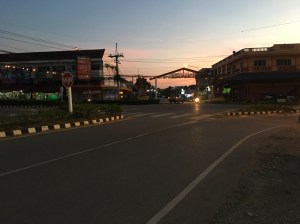
Downtown Chiang Muan at sunset on a Saturday night.
I am staying in the largest of these villages which fortunately sports two small hotels. My first choice had a for sale sign hung on the office door, and no one was around. My second choice did not have a for sale sign, but also was deserted. Fortunately, the phone number on the sign worked and rustled up a gap-toothed local guy in a beat up pickup truck. He took my money and gave me a key, no passport, no sign in, no credit card. I love these small villages! The hotel (not sure it qualifies as a hotel with only 4 rooms) was actually very nice with a decent sized, clean room with a/c, hot water, twin beds, and a small refrigerator all for the princely sum of 500 baht (just over $15).
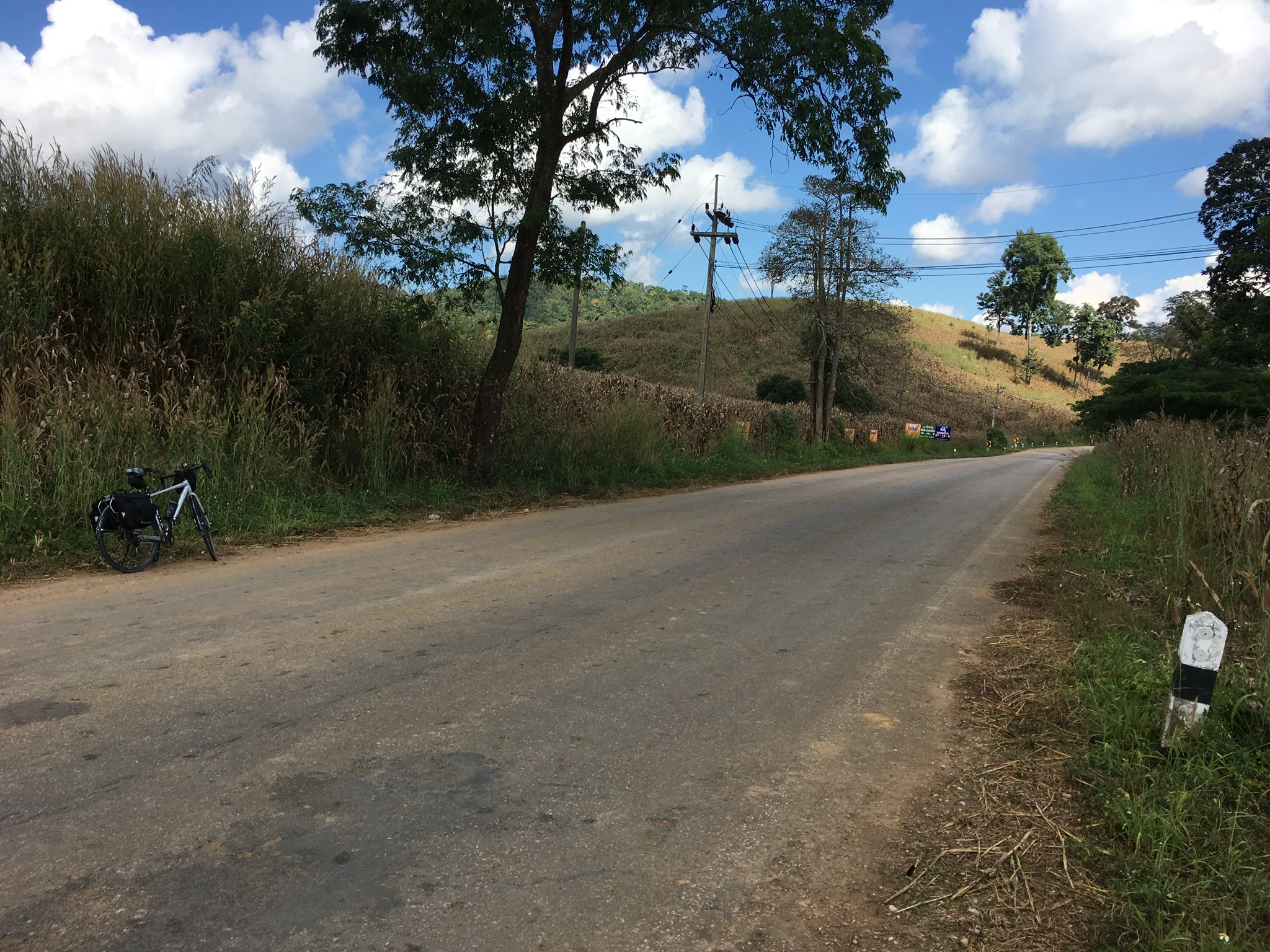
A deserted road – just how I like it.
Todays ride took me over one of the many branches of the Phi Pan Nam Mountains. Here the range is not particularly high, my high point for the day topped out at just under 700 m. All but the steepest slopes were covered with corn fields turned to the their post-harvest brown. The ride over the mountains was very peaceful, no traffic, no villages, and only the occasional farmer tending their fields and waving at the crazy man huffing and puffing up the hills.
Tomorrow I will reach the “summit” of my trip. I have always looked at Nan as being my ultimate destination. A shortish ride over another range of hills should get me there by early afternoon. Talk to you from there.
Today’s route from Phayao on left to Chiang Muan on the right.
The gentler slopes of the mountains were covered in brown cornfields.
Roly-poly hills greeted me after a fast 25 km on the plains south of Phayao.
The reward for a hard-days ride.
Lots of traditional stilted, teak houses in Chiang Muan
Wild Saturday night in Chiang Muan. Maybe it will be packed later?
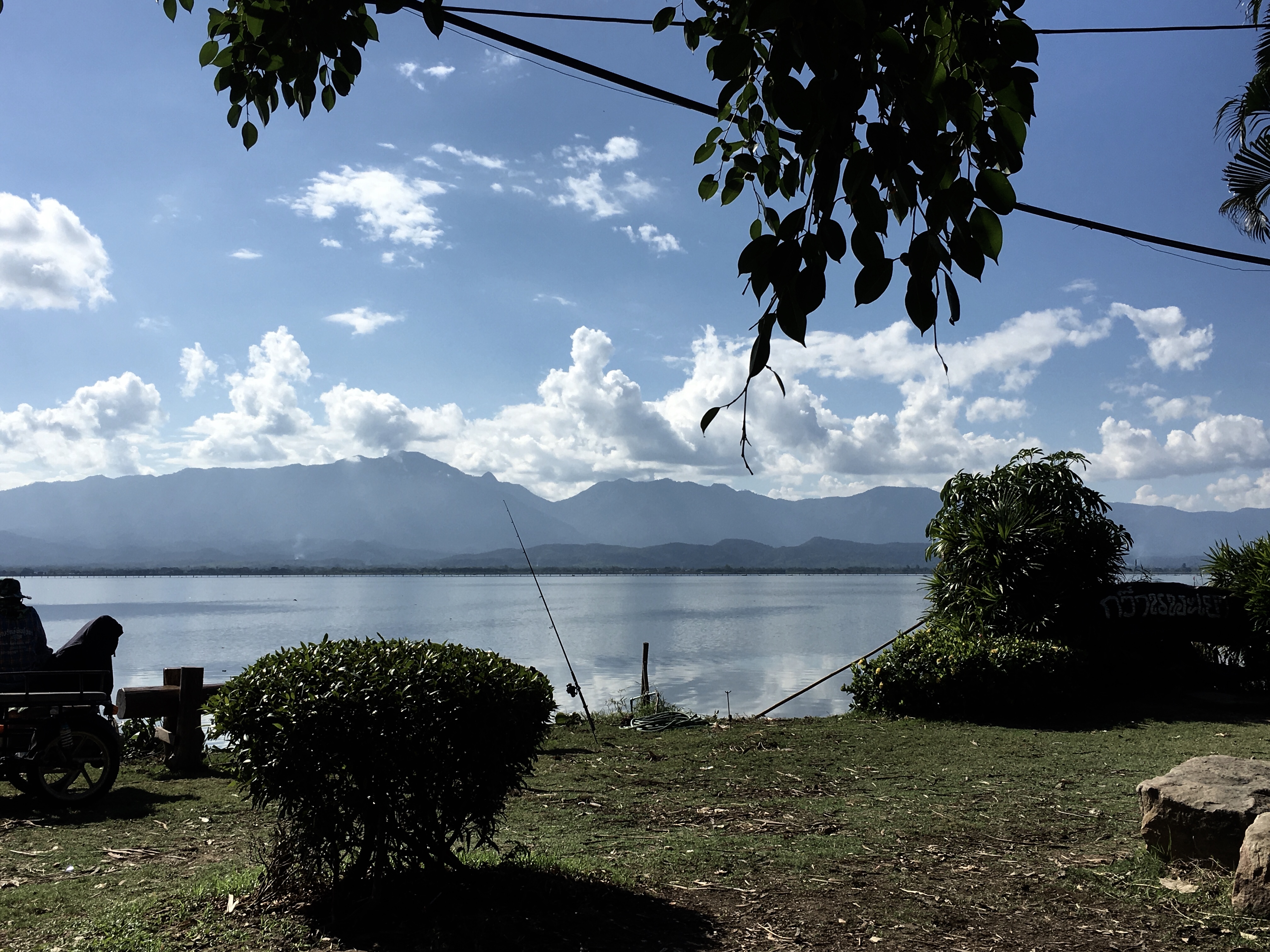
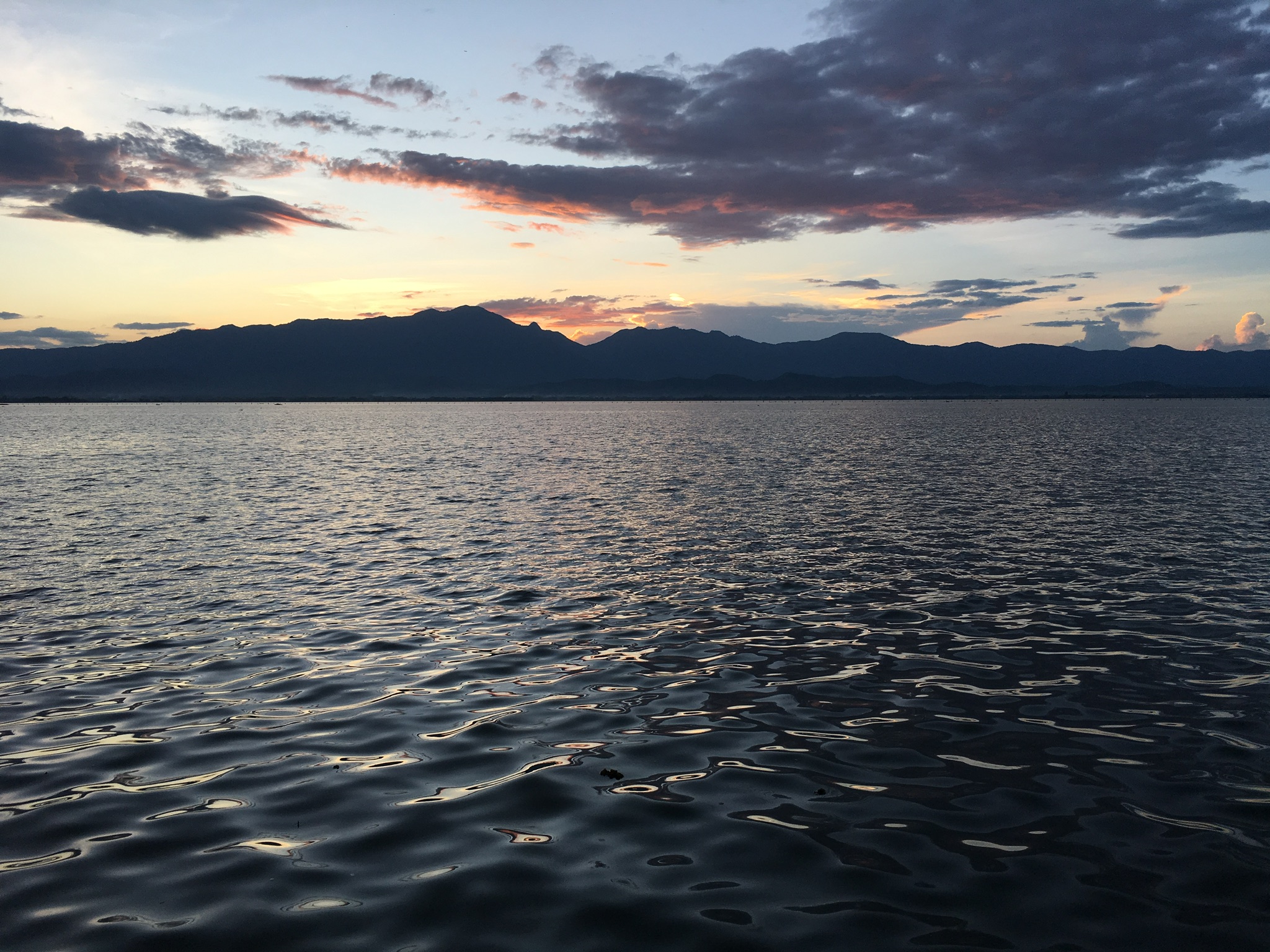
Today I cruised down 87 km southwestward to the provincial capital of Phayao, which lies on the shore of Kwan Phayao (Kwan = lake in Thai). Kwan Phayao is one of the few fresh water lake in Thailand, and one could argue that it is the remnant of a system of lakes that occupied the basins of northern Thailand 15 million years ago. During the last few million years, uplift affected all of northern Thailand, essentially draining the lakes as through-going, southward-flowing rivers developed in response to the uplift. It would have been a fantastic cycling trip in those ancient times, riding along lakes, up over mountains, and down to more lakes, with all kinds of weird Miocene mammals around like camels and small horses to chase instead of the semi-feral dogs of the Holocene.
Phayao is a pleasant, clean town but with a vastly underutilized lake front. They do have a small promenade, with a fountain and small park, but with such a fantastic view across the lake to the distant mountains, one would expect them to leverage this into a popular tourist attraction. However, the lake-front pubs and restaurants seem to be mainly populated with locals. I get the impression that Thais see so much water their whole lives that they can’t quite wrap their heads around why us westerners like to look out over water.
The ride today was uneventful. No spills or thrills, just a fast ride on smooth roads through lovely heartland. I will let the pictures do most of the talking:
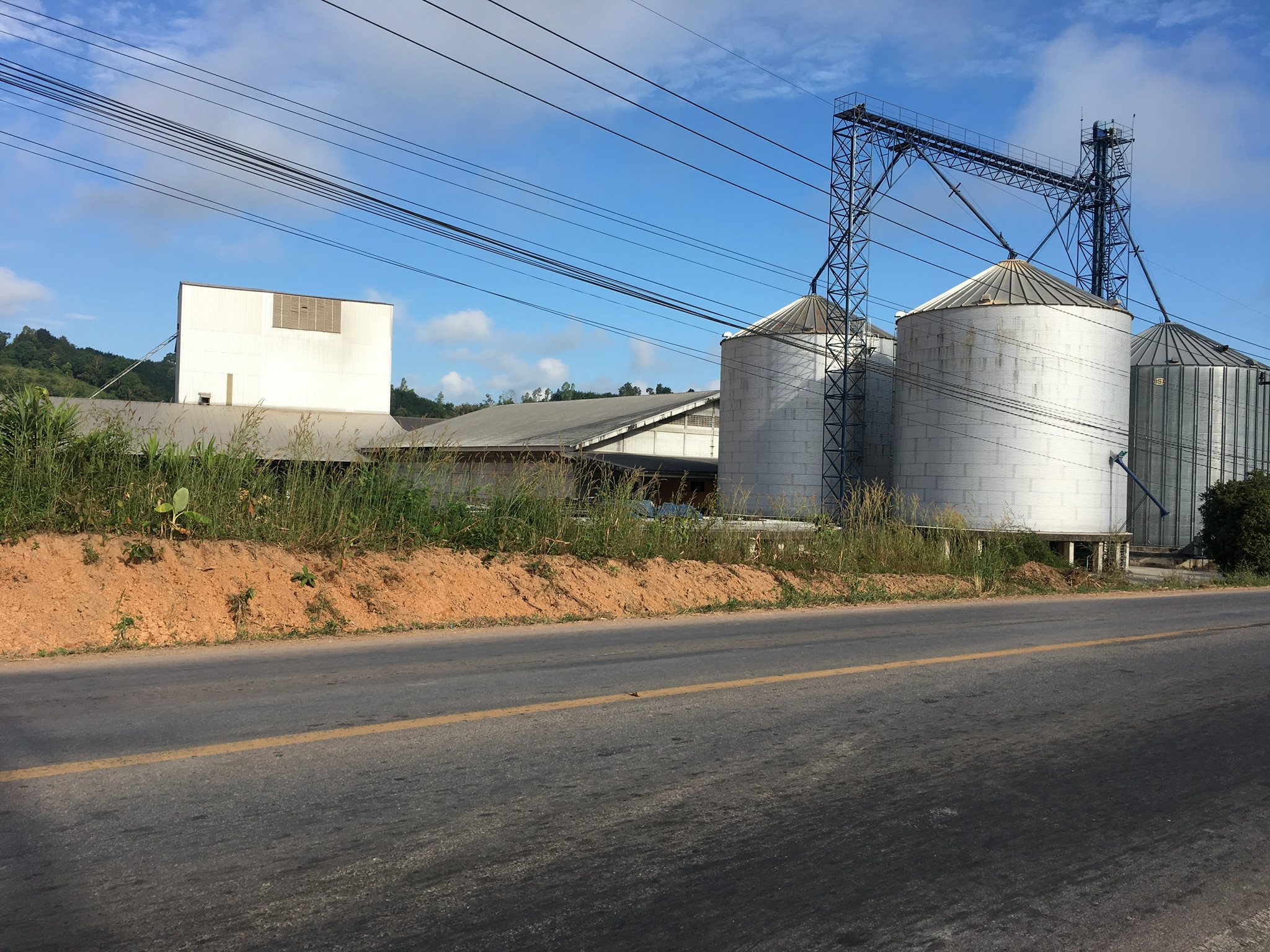
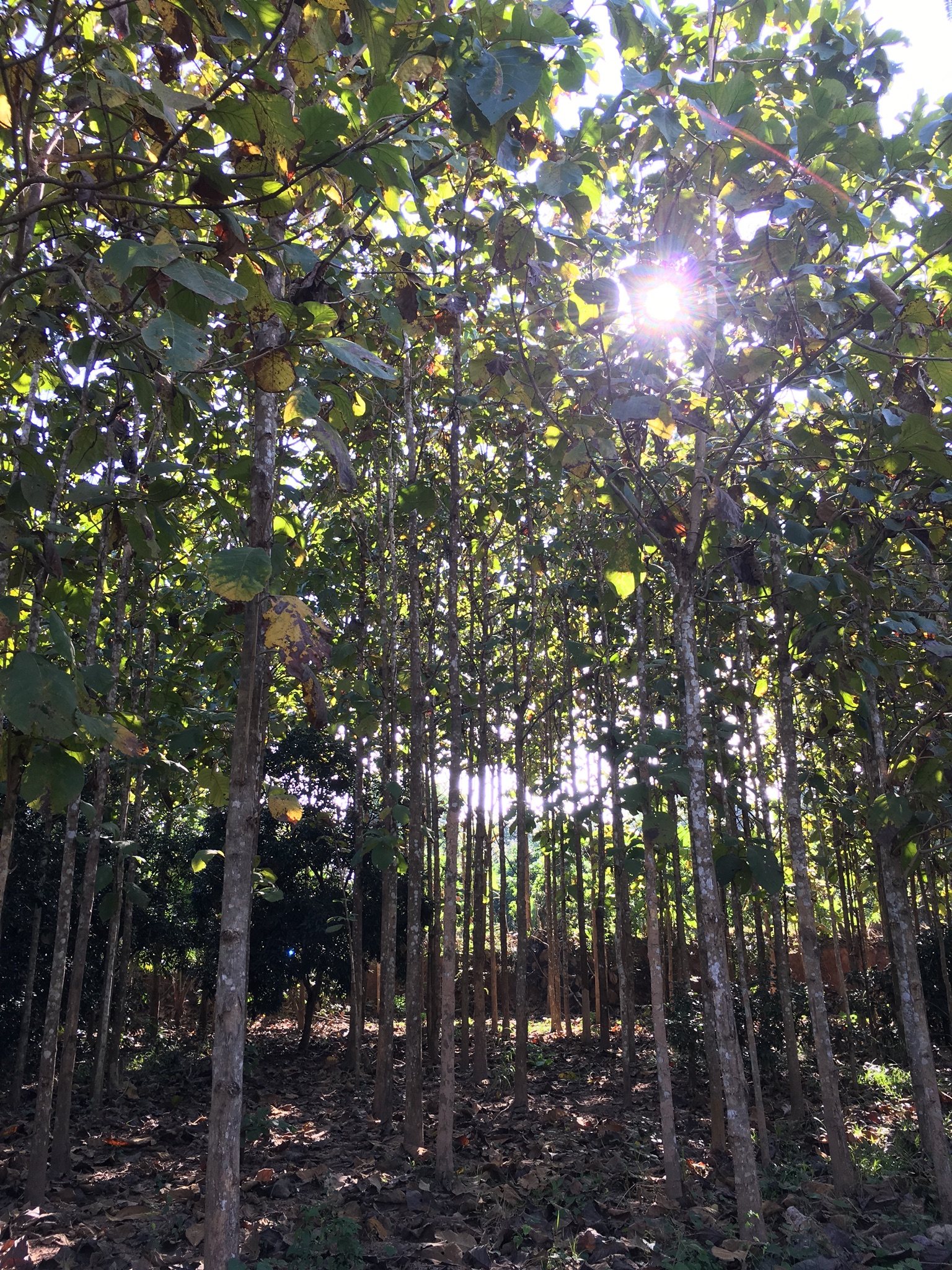
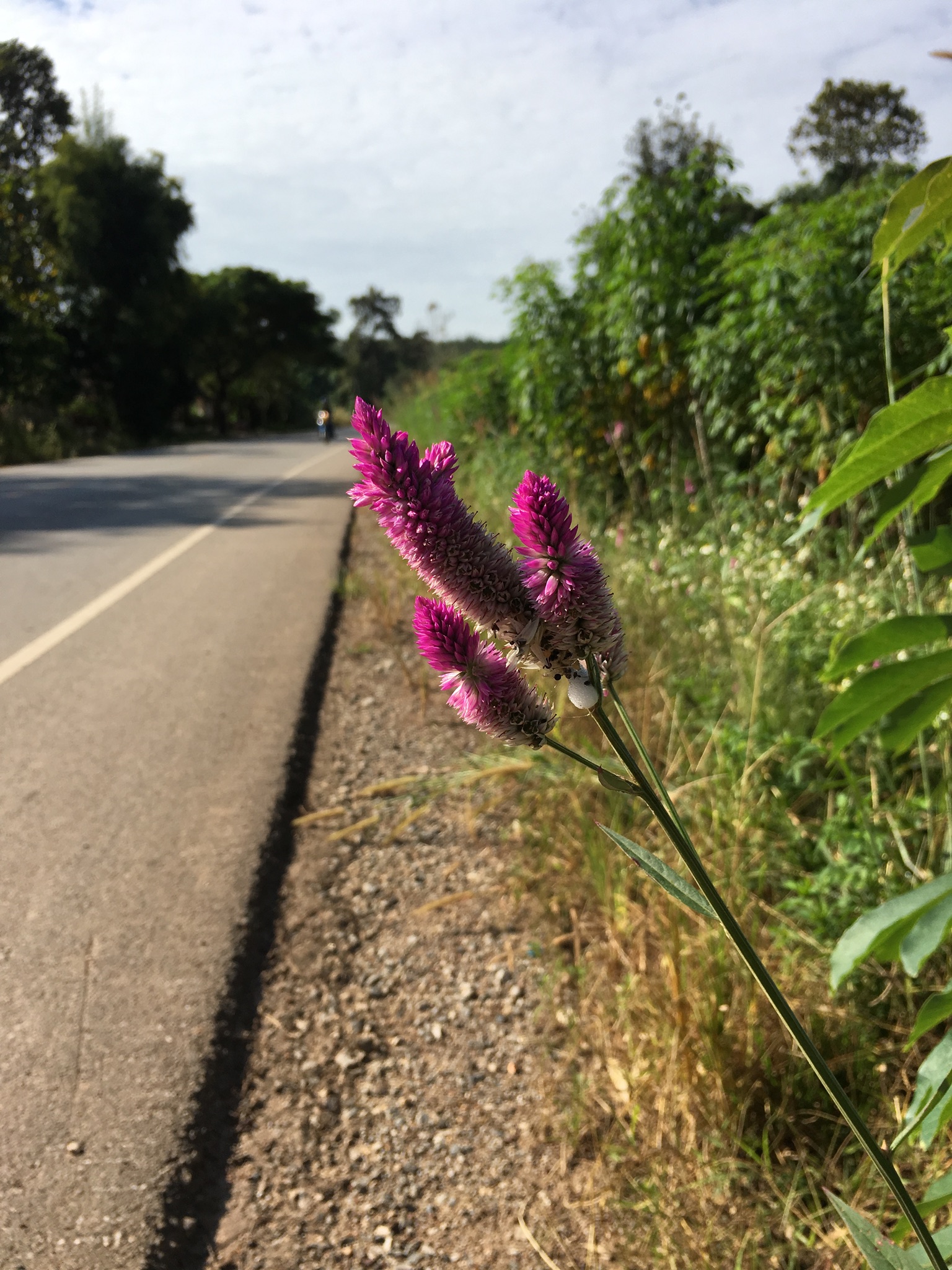
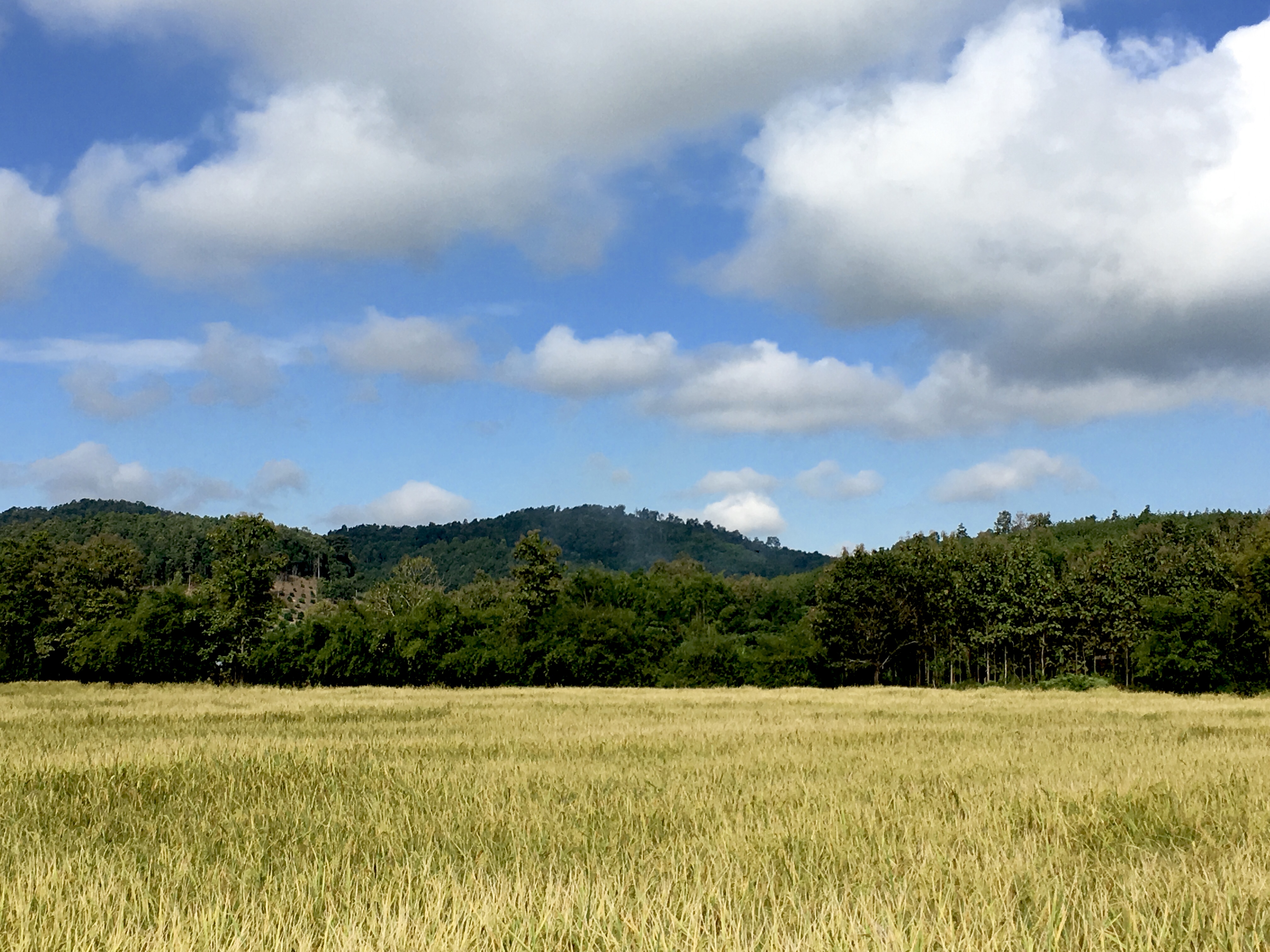
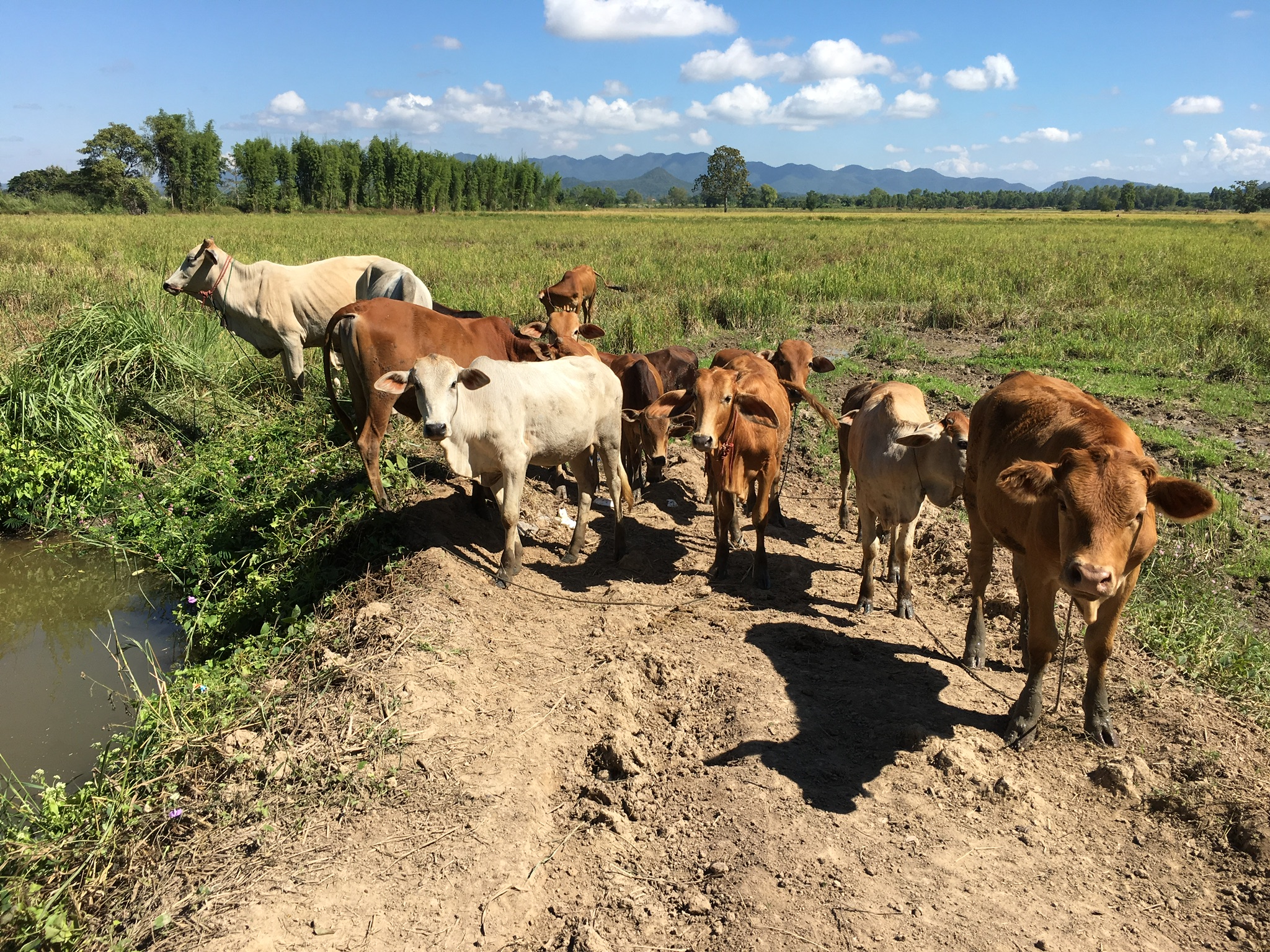
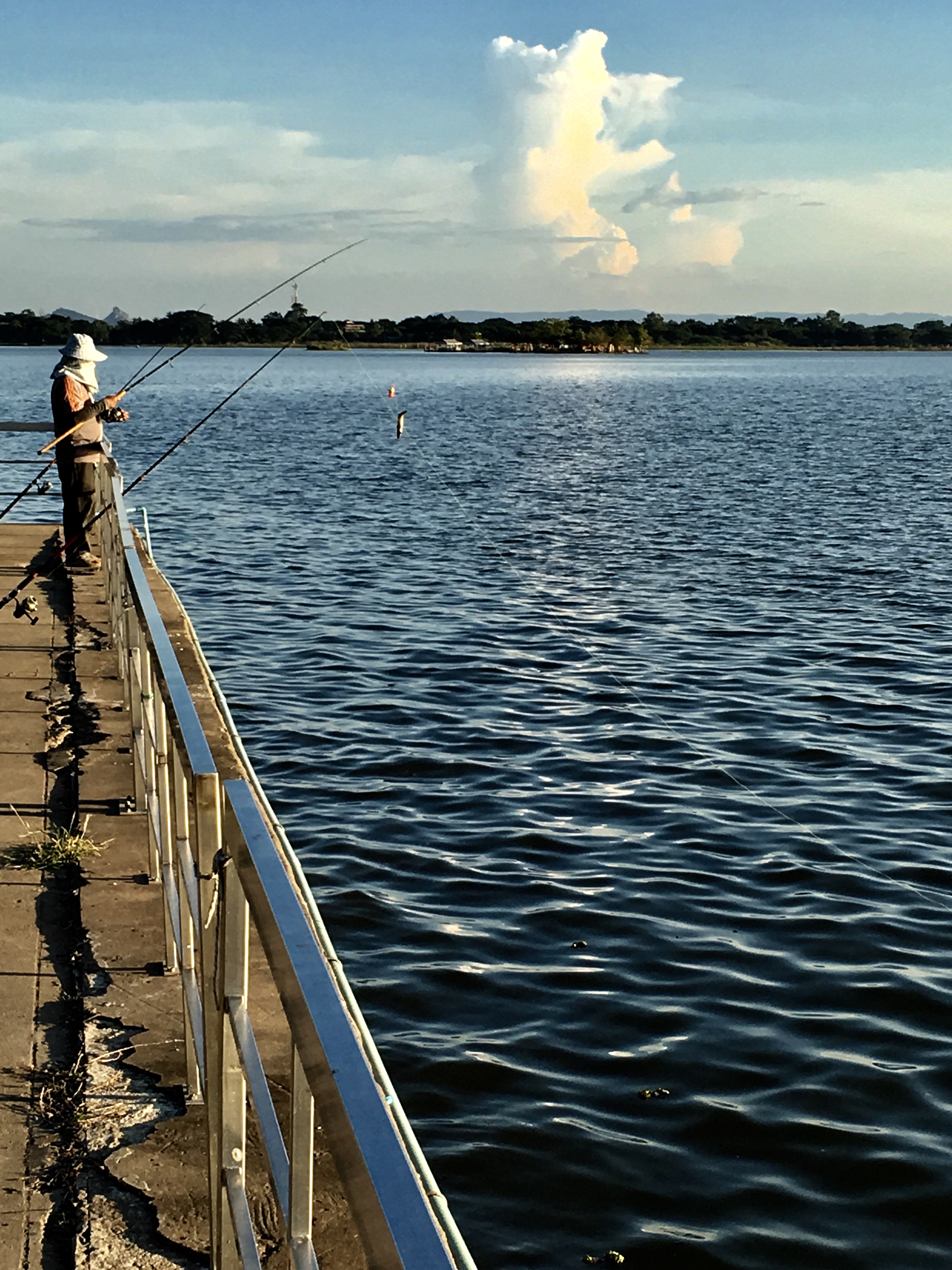
Corn er.. I mean rice silos are a common site in north-central ThailandYoung teak trees (at least that’s what I think they are).Even the weeds are nice.Never tired of the golden rice paddies.Stopped to pee and I had a captive audience!Phayao LakeFishing!A peaceful end to the day.
Tomorrow begins the final 2-day push over the mountains to Nan.











 BaldBrady’s Blog