Luck, Travel and the Virus

I am a lucky bastard. In mid-February I had cancer and traveled to the USA to be evaluated for surgery. I qualified and had surgery on March 3, just about a week before Covid-19 shut down most non-emergency procedures. Lucky. A week later, I was out of the hospital and recuperating at a friends house (thanks to the Kirby’s!). Early the following week I could see the coming lockdown in Thailand and bought a new ticket in an attempt to beat the lockout. I made it home with less than 24 hours to spare. Lucky again. I wasn’t even required to quarantine. Without my lucky timing I would likely be homelessly wandering the streets of LA…or worse.

The lockdown in Thailand was pretty soft. Restaurants could only sell take away, but many businesses stayed open, some with curbside service. Streets were empty for a week or two but then traffic picked up. Tourists mostly fled. By the middle of April, my life was back to normal, but the borders were shut tight and all domestic travel was prohibited. Even Thai citizens living abroad were prohibited from coming home. It worked; locally transmitted cases of Covid-19 plummeted. Gradually, restaurants and golf courses opened, followed by bars, although most places that rely on tourists remain shuttered. The number of Covid cases dwindled to none. The government began allowing Thais to return home, but kept them in fortress-like quarantine. Thailand’s (pending) victory over Covid adds to my lucky streak. There’s a big advantage having an authoritarian government and a fairly obedient citizenry. Finally, domestic tourism began to not only open up, but to be strongly encouraged with some very good “Thai Resident” discounts.

Now it has been well over 2 months since the last local transmission of Covid-19. The only new cases are among the returning Thais (I never realized how many Thais were living in places like Sudan, UAE, Egypt, and everywhere else on the planet). A small percent of those returning tested positive in state quarantine. Last month they began letting in a trickle of foreigners, such as those that had family here, or had work permits. A few of them also have tested positive, but so far the virus has not escaped the quarantines. Best of all, my first post-op MRI came back clean, and I am officially NED (no evidence of disease)! How much luck can I have? Now, with virtually no foreign tourists, and many hungry resorts, Jane and I have set out for a domestic adventure.

Booking a trip was a bit difficult, with resorts and airlines unsure or uncommitted to opening. It took two tries to book our airline tickets and two tries to book a resort. Our first stop was Khao Sok National Park.

Traveling by air within Thailand was easy and convenient. Masks required, and no food or drink on board – even the seat pockets were emptied. But all seats were used, and outside of temperature checks and logging in to the Thai Chana (translates as “Thailand Wins”) surveillance app, the travel was uneventful. With no security or check-in queues, air travel was easy and pleasant.
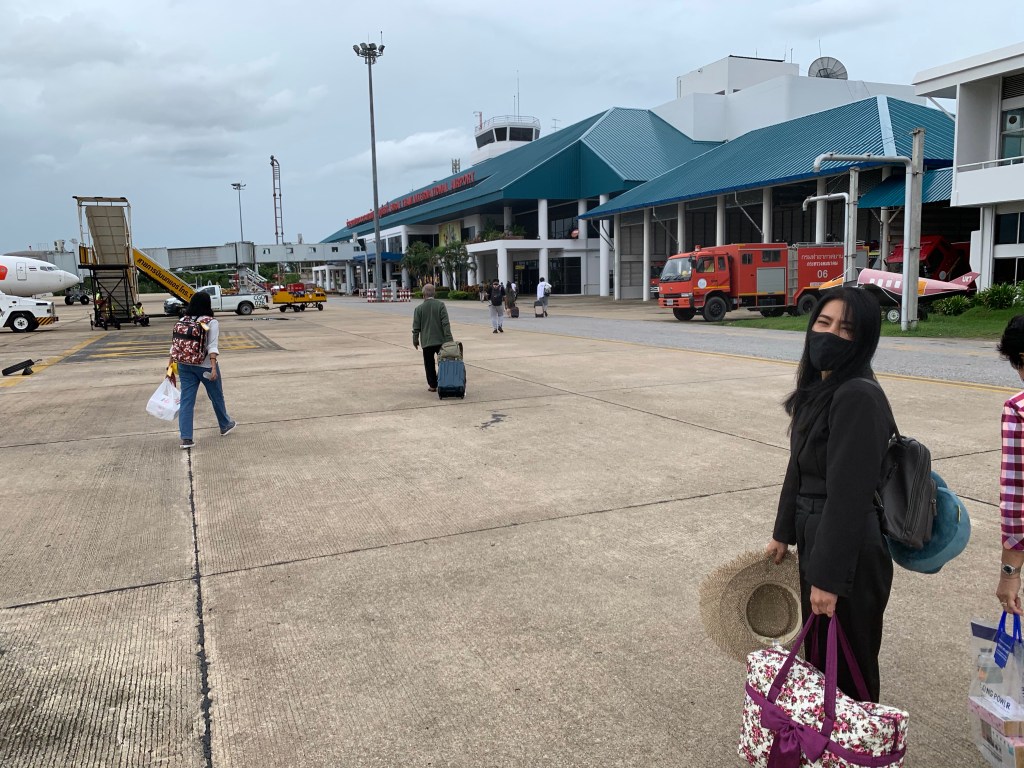
Masks up upon arrival at Surat Thani airport.

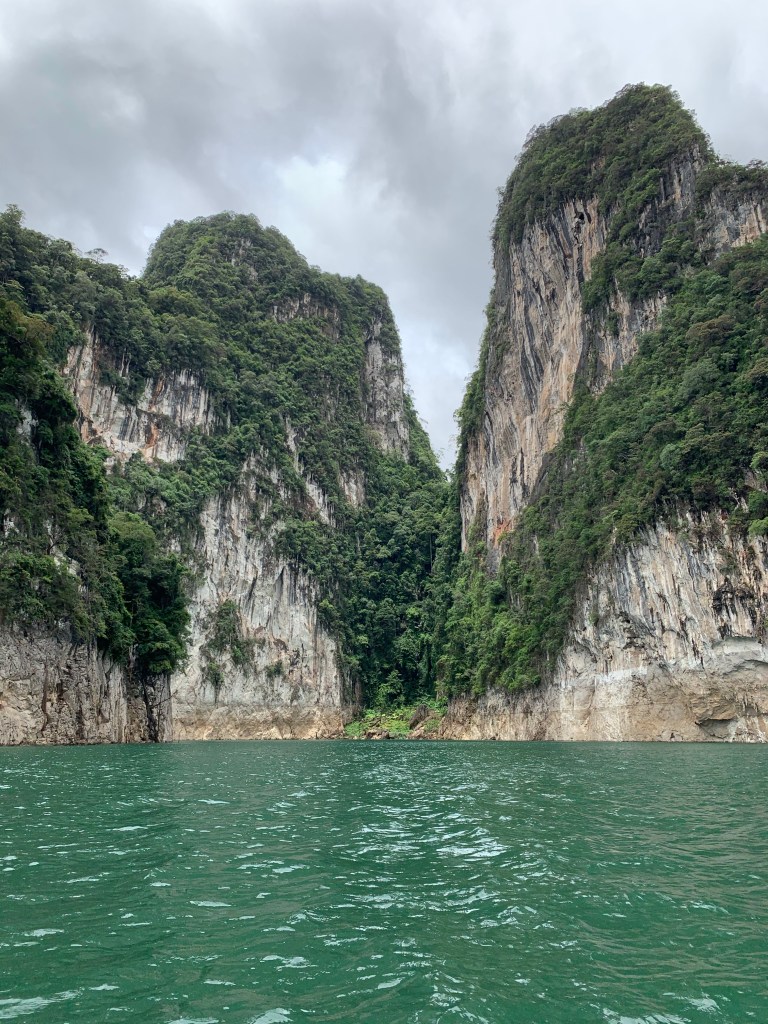
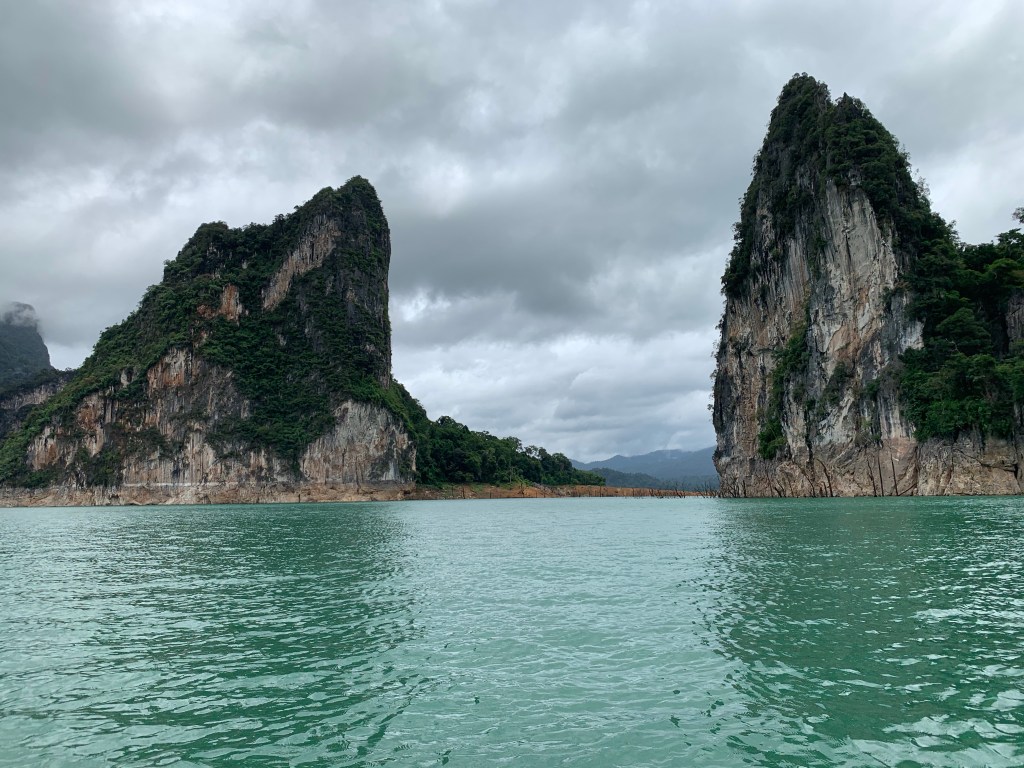
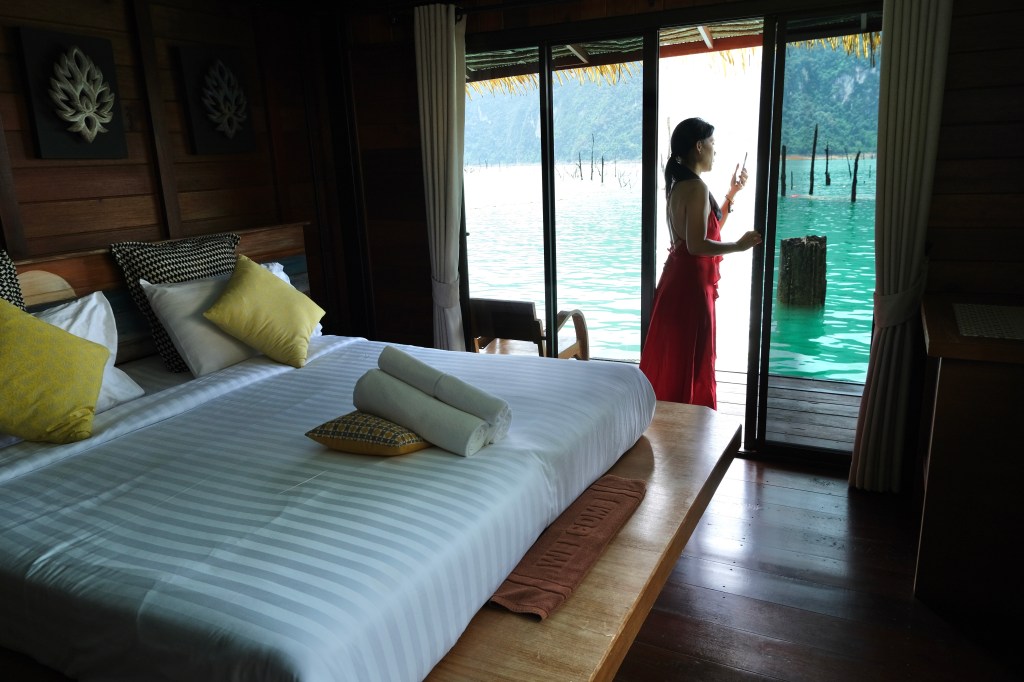
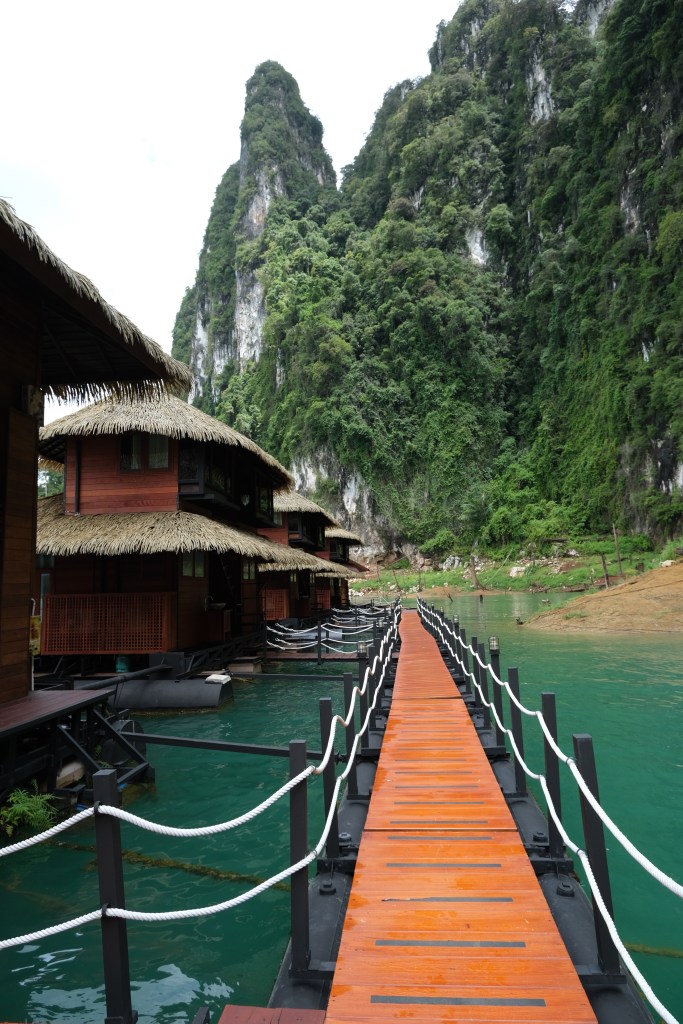
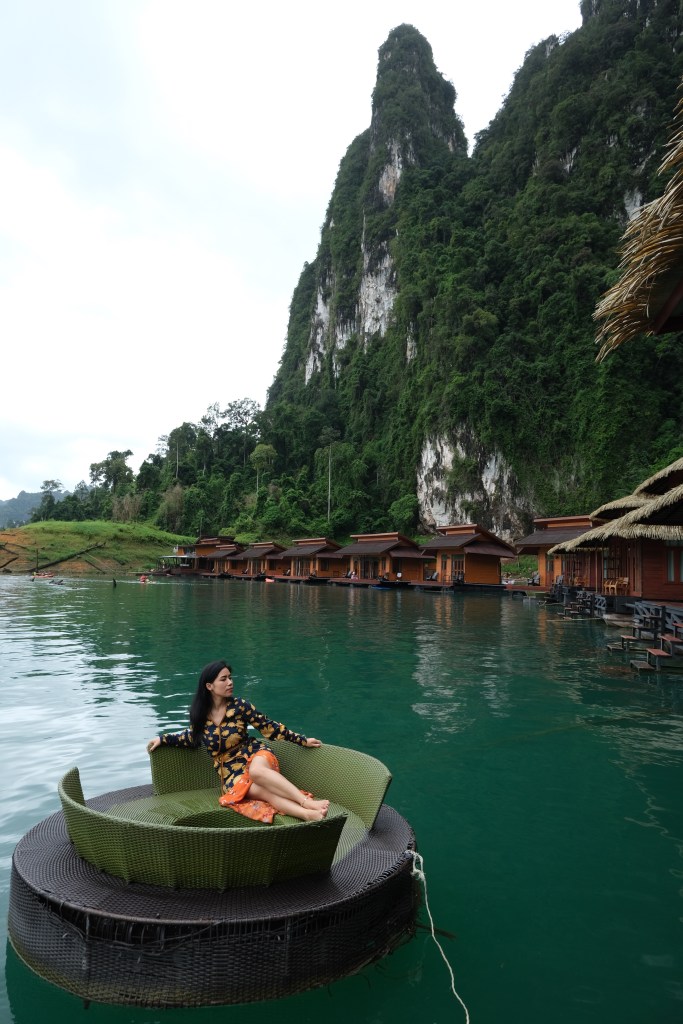
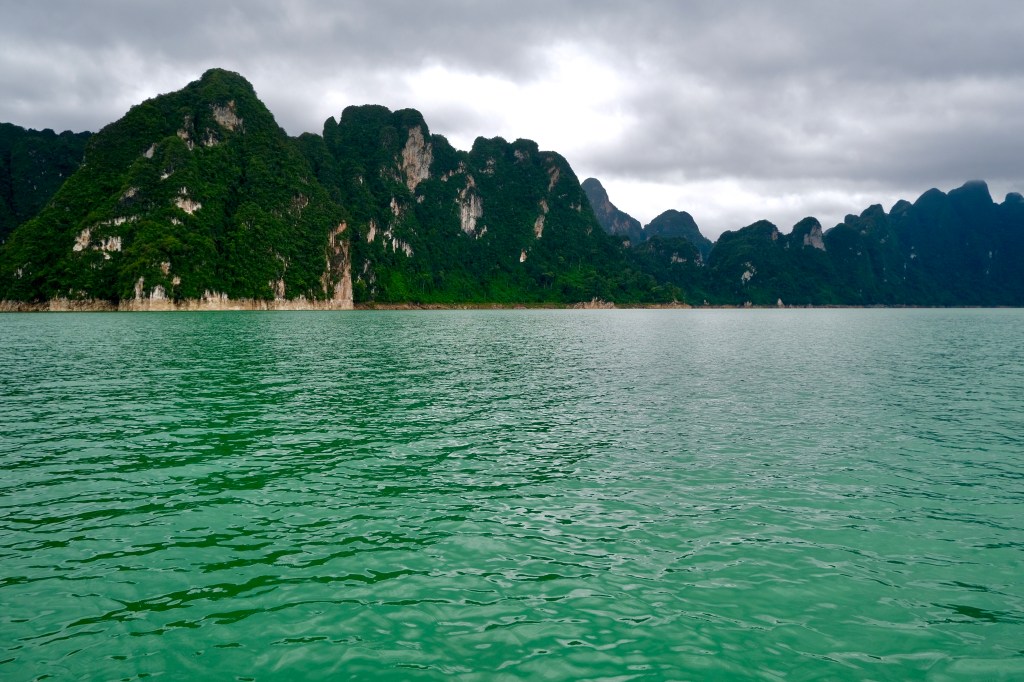
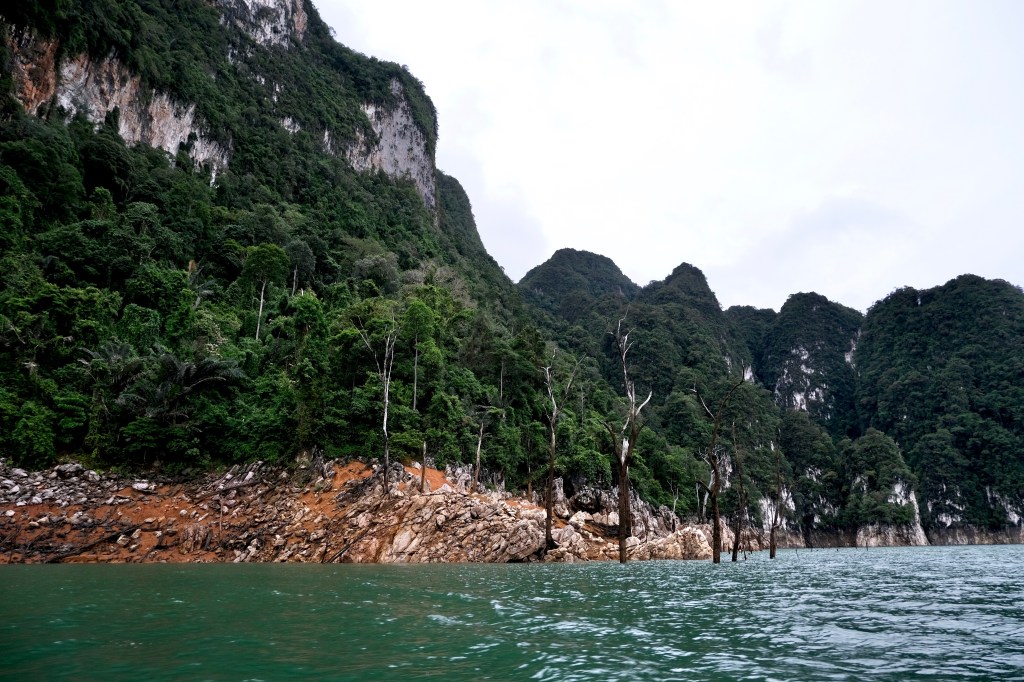
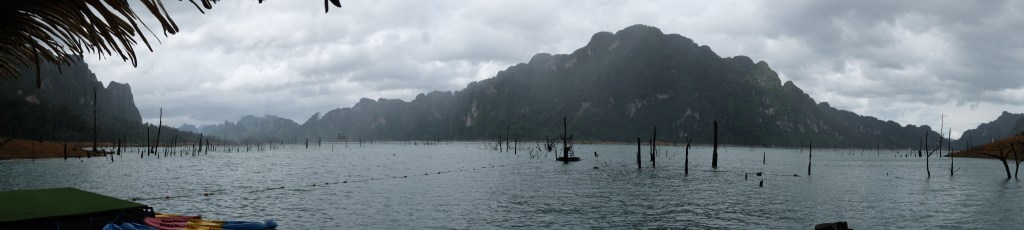
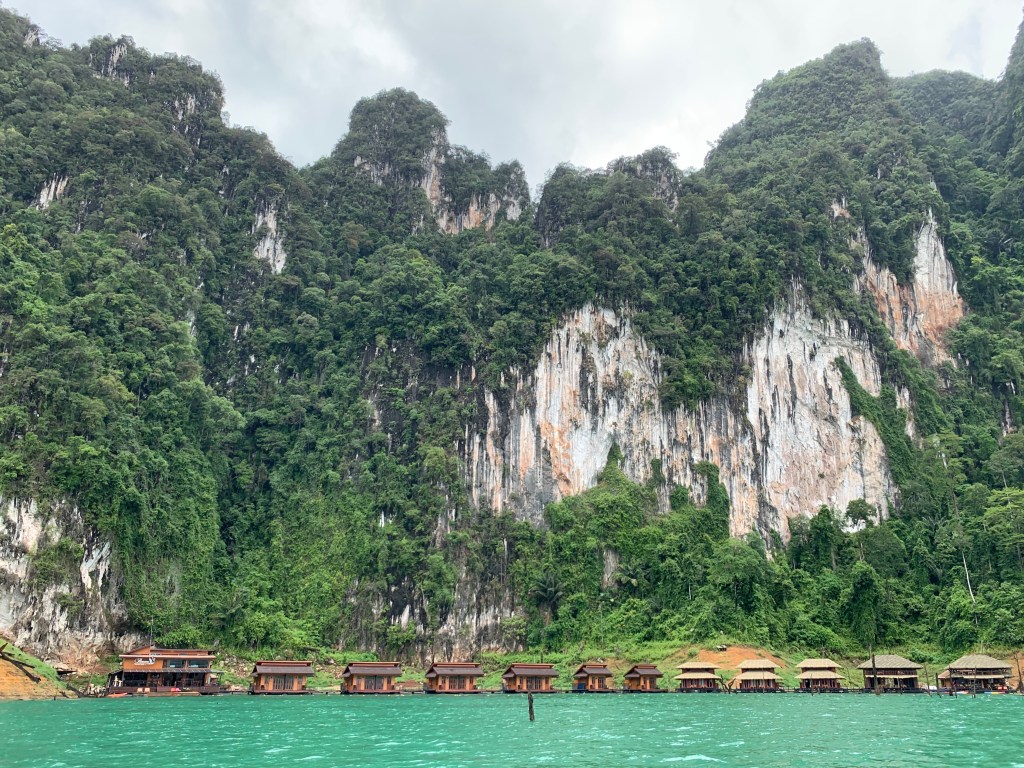
Our first stop for 2 nights was Khao Sok National Park. The Park’s main attraction is the large reservoir backed up behind Ratchaprapha Dam. The dam, completed in 1987, flooded towering karst topography and virgin rainforest. This area is the wettest in Thailand, with over 3500 mm (138 in) of annual accumulation. Long-tail boats service several floating hotels anchored to the wilderness shoreline. We stayed at the Panvaree the Greenery, a high-end option about 45 scenic minutes from the Dam.
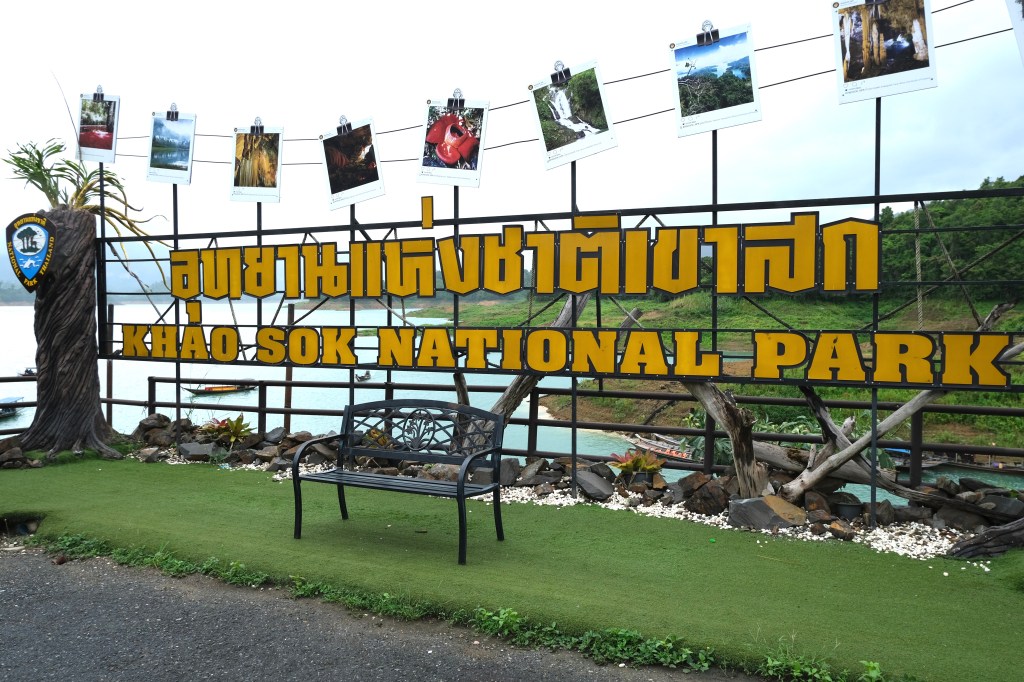
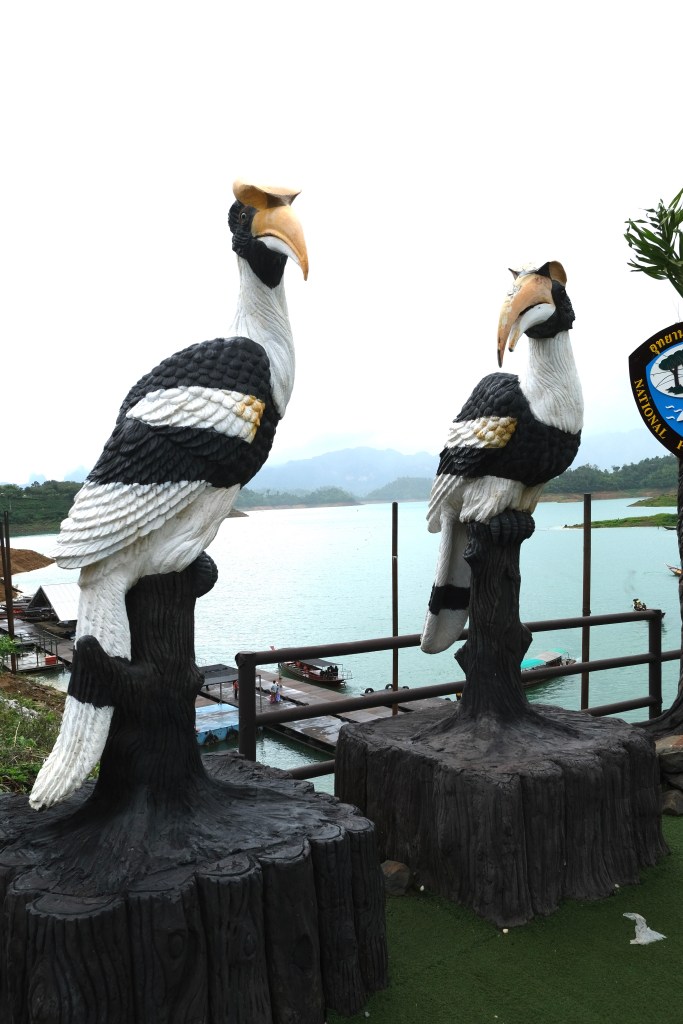
The weather during our stay was drizzly and dreary, fitting for one of the wettest places in Thailand. On our first night, we had quite an overnight storm that left us a bit queasy, and blew away some cloths we had hung out to dry. The next morning, the resort staff couldn’t find their rescue boat. Finally they realized that it sunk in the storm!
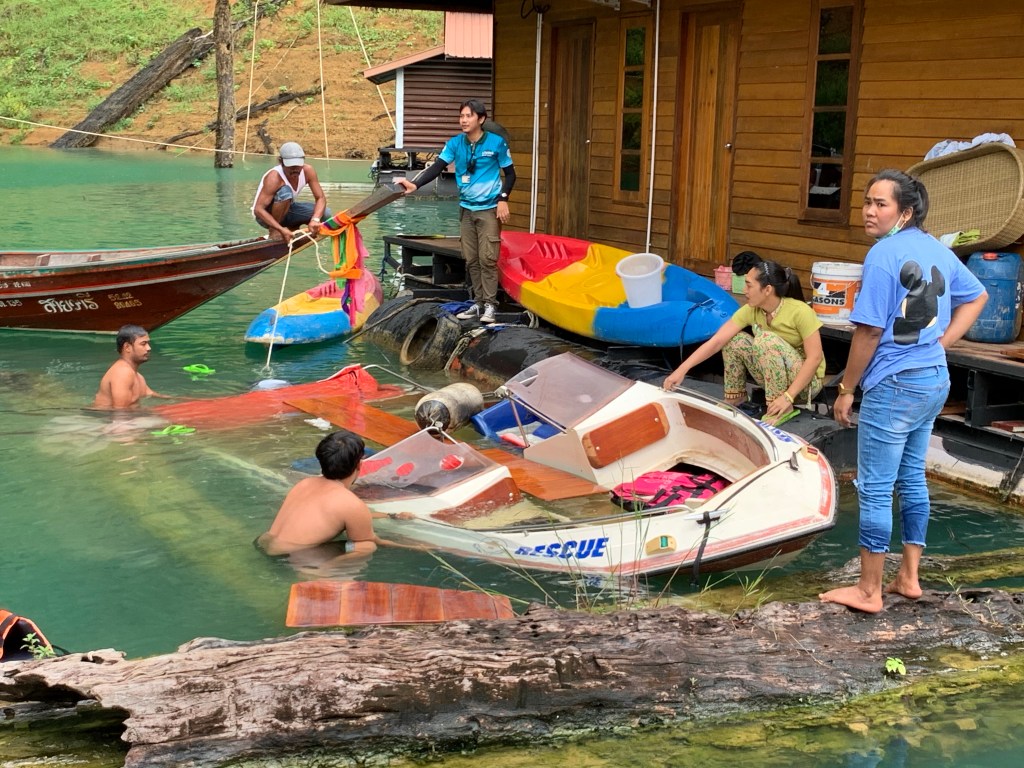
The staff spent several hours refloating their “rescue” boat.

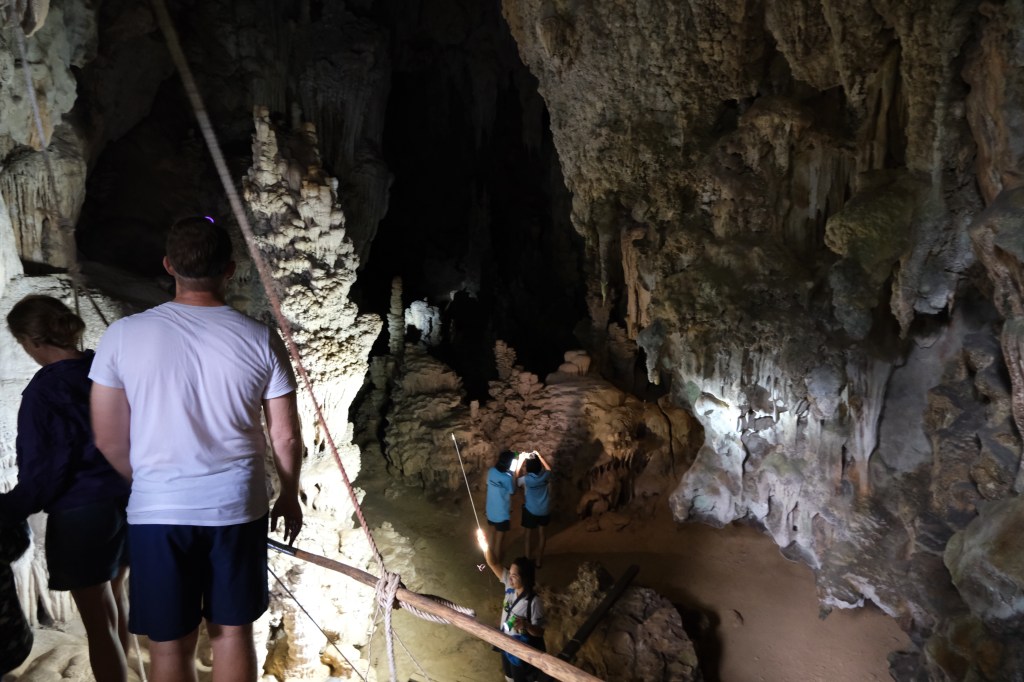
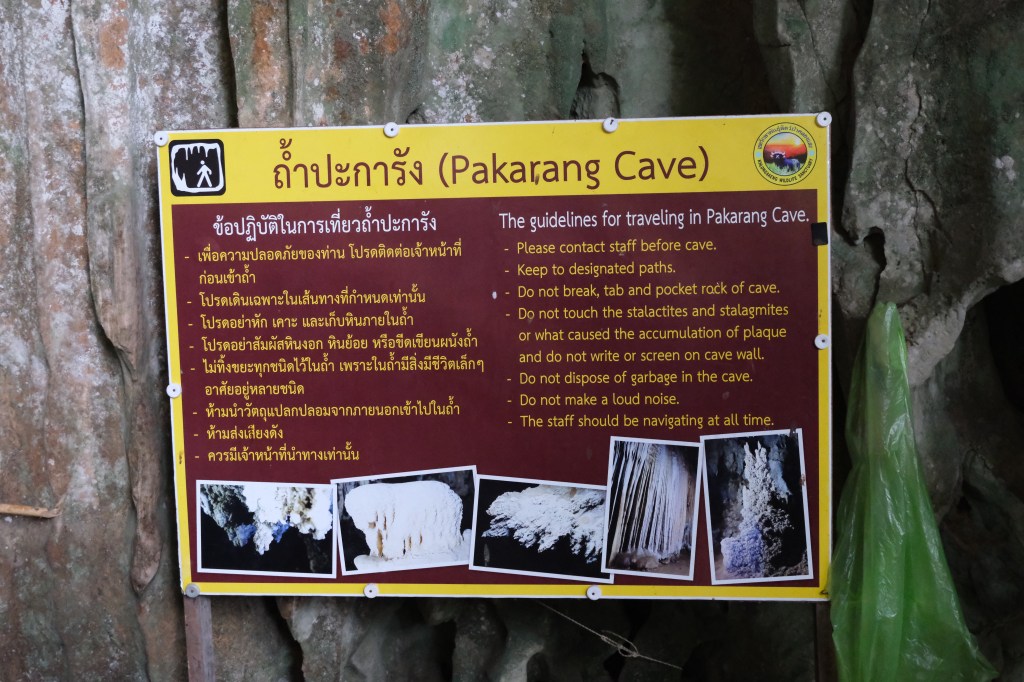
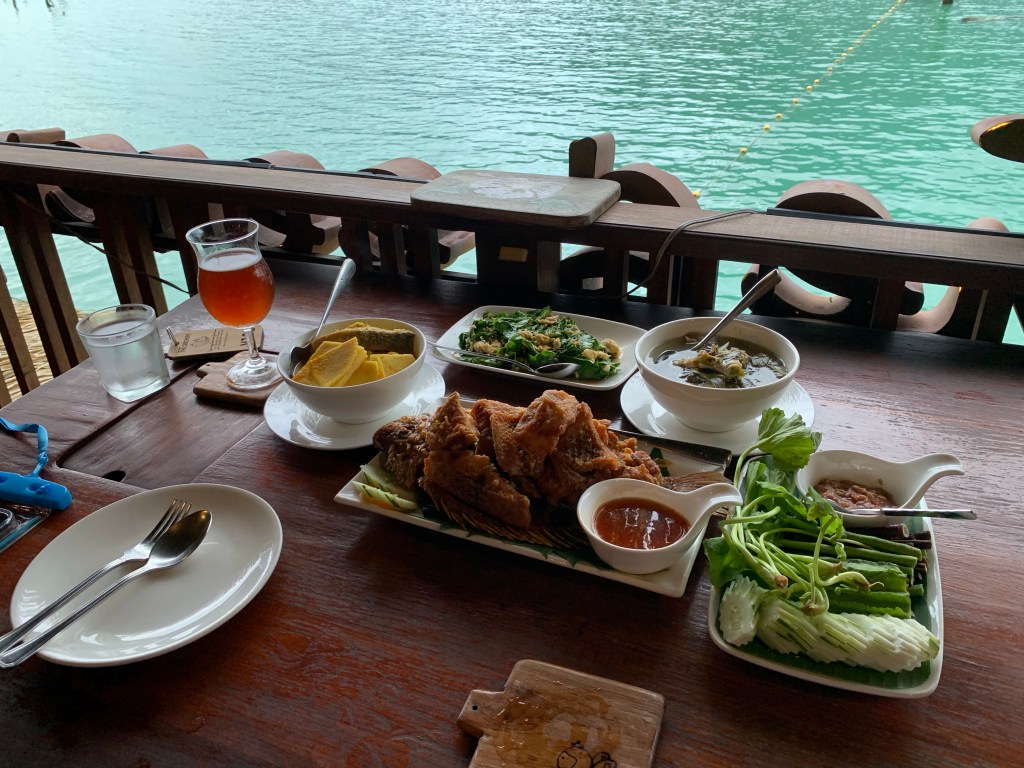
The highlights of our stay included kayaking the local waters, hiking to a jungle cave festooned with glittering stalagmites and stalactites, and enjoying delicious and abundant southern Thai food at our floating home. I highly recommend the Panvaree – very friendly and comfortable for a floating, wilderness resort. But I couldn’t help but feel melancholy about the entire experience.
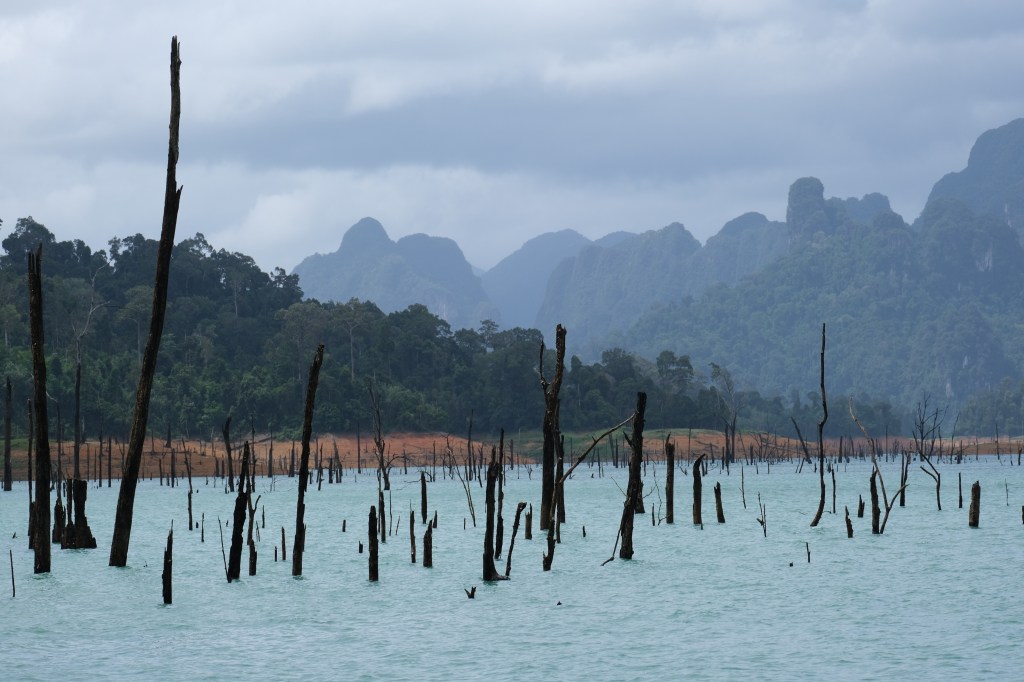
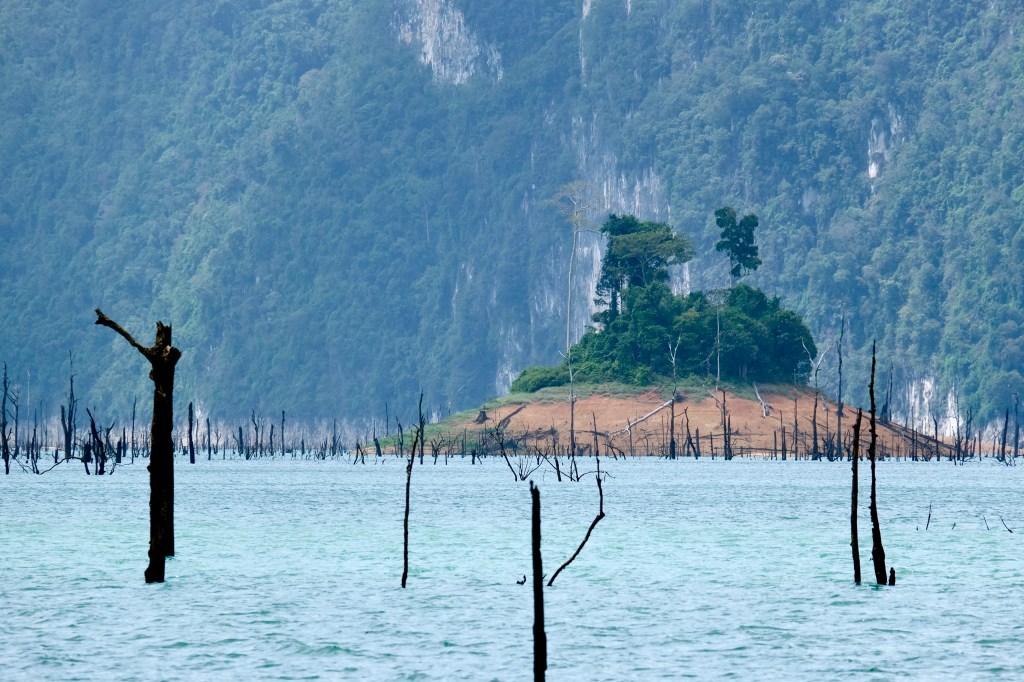
The low water level of the reservoir exposed about 10 m of normally submerged shoreline and the exposed, drowned deadwood constantly reminded me of what a beautiful albeit inaccessible place this must have been before the engineers arrived. The building of the Dam necessitated moving several villages and displaced more than 300 households, but also generates 240 megawatts of hydroelectric power and fuels a small tourist industry surrounding and within the park. For anyone willing to swallow these contradictions, I would advise visiting the lake when the reservoir is full; that way at least you can pretend the lake is natural.
Our trip will continue on Koh Phangan.
Out of the Tunnel

It has already been two weeks since the operation to remove a NET from my mesentery.  My ordeal began on Monday, March 2 at 5 pm when I checked into Cedars-Sinai Medical Center for an unusual early-evening combined colonoscopy and endoscopy.  I remember nothing of these procedures other than waking up about 30 minutes later with a blurry doctor telling me he found nothing. My innards were perfectly clean as far as he could see, which is pretty amazing considering the abuse I have subjected them to over the years.   Since my surgery was scheduled for the next morning at 7 am, they kept me right there in the hospital.

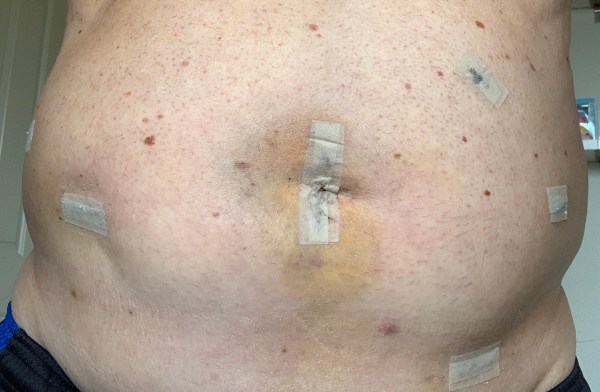
IMG_1701
Five tiny incisions, and one slightly larger one.  I’m pretty sure I no longer have a belly button.

The next several hours were a blur.  I think they must have slipped me something.  The last thing I remember was looking at the red digital clock across the room and seeing 7:00 a.m.  I awoke amid a misty commotion all around me of doctors and nurses.  I squinted through the chaos and saw another red LED clock that read 10:00 PM……Holy shit!  10 PM???  I remember doing the math and thinking I was out 13 hours!!!! Later I figured out it was really 15 hours!  I was expecting 2-3 hours.  Early the next morning I was told the operation actually took 9 hours, but it took me another 6 hours to come out of the anesthesia.

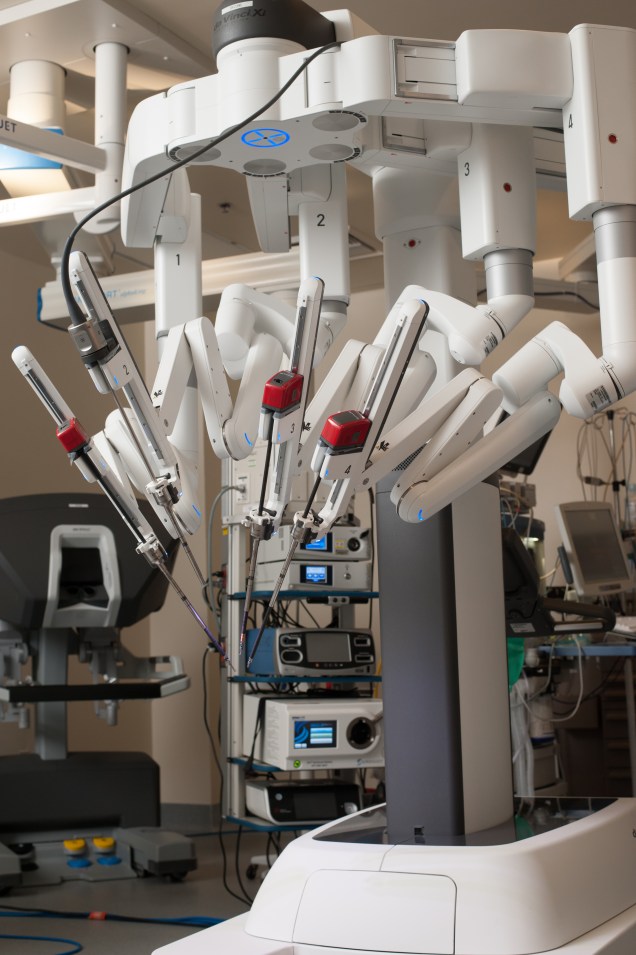
According to my surgeon, who stopped by the morning after, the surgery took much longer than anticipated due to the positioning of my mesenteric tumor amidst a jungle of critical blood vessels.  If he were to nip one of them, I could lose half my bowels.  He made the decision to go 100% robotic knowing that this would triple or quadruple the time for the operation, but allow for very precise cuts.  As a bonus, they found the primary (e.g. “original”) tumor in my small intestine, which they resected. I have been assured that I won’t miss the 9 cm of removed bowel.  The primary tumor was not visible on any of the previous scans, and that they found it is of great significance.  There was no longer any mystery about the source of my mesenteric tumor, and by removing the primary tumor, my chances of a quick recurrence should be reduced.

IMG_1693
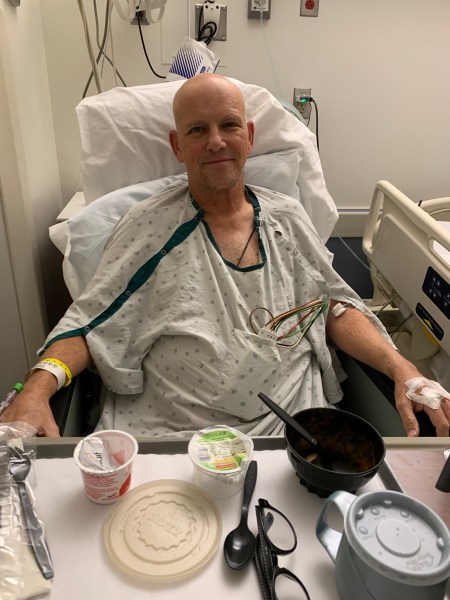
Day 3 in the hospital.  I look way better than I feel.

My doctor asked how I was feeling, and I told him I felt like someone punched 6 small to big holes in my belly, rummaged through my entire digestive tract, then yanked out a sizable section out through my belly button.  And then Mike Tyson used my belly for a punching bag for 5 minutes.  Actually, except for Mike, that is pretty much just what happened.

The next 6 days were a roller coaster of progress and setbacks, including an infection of unknown origin that left me feverish for 2 nights, getting dropped by a rushing X-ray tech (set me back at least 1 day), spasming at my first attempt to drink a clear liquid, and pained shuffles up and down the corridors.  But progress finally won out over the setbacks, and they released me almost exactly 1 week after I was admitted.

I made my final visit today to Cedars-Sinai for a last follow up with my surgeon.  He gave me the good news that I am officially NED (no evidence of disease)!  But Neuroendocrine tumors, even when you’ve had them removed, have a propensity to recur.  So I will be on a surveillance program, with scans every 3 months for at least the first year.  They are recommending that I can stop the monthly injections that I have been getting to slow down the cancers growth (a big relief to my digestive system).  This is all the best news I could have hoped for!

The care I received at Cedars-Sinai was amazing, from the orderlies, nurses, technicians (well, except for that one harried X-ray tech) and the dozen or more doctors that were involved in my care.  My main team consisted of my surgeon, a NET oncologist, gastroenterologist, and urologist.  All of them have been caring, funny, and exuding professional competence.  In spite of this being the most difficult medical journey of my life, I feel like I made the best choice!

I’ve now been staying with close friends just waiting to heal up sufficiently to fly back home to Thailand.  In the meantime, the world has imploded with the Covid-19 pandemic and it’s now a race against time through a dark tunnel to get back home before Thailand closes its gates.  If I can’t get back in time, I will be officially homeless…

Operation California

My surgeon!

I am currently sitting at Black Canyon Coffee at the Chiang Mai airport waiting for my flight back to California.  In a few days, I hope to be getting surgery to remove an alien growing on my mesentery.  This is a good thing.

It took me 4 scans, 2 biopsies, 8 shots in the ass, and more trips to Bangkok Hospital than I can remember, to get to this point.  Finally after ruling out prostate cancer, and getting a diagnostic confirmation from the Cleveland Clinic, it all comes down to this one 2.5×1.5 cm tumor.  The consensus is get it out if at all possible.

I talked with two surgeons affiliated with Bangkok Hospital.  One was willing to do the traditional slice and dice procedure, and the other one was an expert in laparoscopic (minimally invasive aka. key-hole) surgery.  Neither had any experience excising neuroendocrine tumors.  I had to wonder if they would even know what one looked like. So I went on the internet.  It turns out there are only a handful of facilities in the USA that have a specialization in Neuroendocrine Tumors (NETs).  It boiled down to choosing between Dana-Farber Cancer Institute in Boston, The James Cancer Center in Columbus Ohio, City of Hope in Duarte, California, and Cedars-Sinai Medical Center in Los Angeles.  One didn’t take my insurance, and one didn’t follow-up after 3-4 emails.  In the end, I chose the Carcinoid and Neuroendocrine Tumor Program at Cedars-Sinai.  In about 48 hours, I have an appointment with a surgeon who specializes in NET tumors.  Not to disparage my doctors in Chiang Mai, all of whom gave me excellent care, but this feels like moving up to the big leagues.

My prospective surgeon, Dr. Kosari, has reviewed my scans and believes the tumor is resectable (Doc speak for “yea, we can cut it out”) and likely can be done minimally invasively using a robotic assist.  As the picture shows, the robot looks a little scary.  Sean Connery would agree.

I want to emphasize that my disease has not worsened or progressed.  Surgery, if possible, is a good thing (my new mantra).  My disease will still be there, will still be incurable (BUT NOT TERMINAL).  If successful this will be a step towards my ultimate goal – high life-quality while waiting for something else to kill me.  Stay tuned.

Medical Care in Thailand: Observations from a Reluctant Patient.

imagesI am now 7 months into my battle with Nueroenocrine cancer.   I have had way more contact with the medical community here in Chiang Mai than I ever wished for.  I always figured that most people died in a hospital bed, so better to stay away.  However, I now feel somewhat qualified to make some observations about health care in Thailand that might prove useful to anyone thinking about retiring or traveling here for medical care.

An Update

But first, a very brief update of my current status.  I have now been on monthly injections of Sandostatin LAR for 5 months.  These injections are not a cure, but intended to stop or slow the tumor growth, and stop or limit the proliferation of tumors.  They do come with some unpleasant, but mostly bearable, digestive side-effects. Suffice it to say that if I had one of the more common side effects then, I would have been a cult hero in my fifth grade class.  Last month, I traveled to Bangkok for another Gallium 68 PET scan.  The scan showed no growth of my one known tumor, but continued to “light up” my prostate, suggesting something might be there too.  Last week, I had a biopsy done on my prostate where my urologist turned it into a pin cushion by removing 24 small cores.  Fortunately, I was in Lala Land at the time.  Early this week I got the results: nothing at all going on there (except BPH which I have known about for years).  Good news!

I will be meeting with my oncologists next week to discuss our next move (surgery or more Sandostatin injections are the two most likely).  Unfortunately, the one known tumor is in my mesentery, and is very unlikely to be the primary.  Where the hell is my primary?  Most likely it is 1. too small to see, 2. gone already due to immune response, or 3.  hidden away somewhere, most likely in the curlicues of my small intestine.  Neuroendocrine tumors (NETs in the lingo) are sneaky nefarious bastards.  Once they have metastasized they are nearly impossible to 100% expunge from your system via surgery or medicine.  This will make the decision to cut or not to cut a difficult one….So that’s where I stand at the moment.  In the meantime, digestive issues not-with-standing, I feel great and life goes on mostly as normal.

Medicine in Thailand

According to the World Health Organization, Thailand ranks #47 amongst 190 countries in terms of the quality of their healthcare system.  For perspective, the U.S. ranks #37.  Thailand, except for the tiny states of Brunei and Singapore, ranks number one in south-east Asia.  Thailand ranks 65 spots above India that magnet for medical tourism.  So by WHO standards, health care is pretty good here.  My own experience corroborates this conclusion.  But it is only good if you have money (or good insurance).

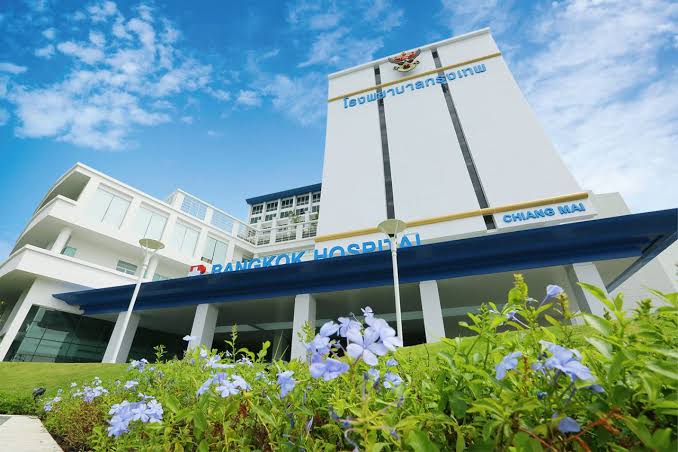
I receive most of my healthcare at Bangkok Hospital, Chiang Mai (BHCM).  Bangkok hospital is a country-wide system of hospitals that was started by a Thai doctor in 1972 as the first private hospital in Thailand. Prasert Prasarttong-Osoth parlayed his medical degree into a $3.2 billion fortune that includes Bangkok Airways and 3 regional airports.  BHCM is in my view the best hospital in Chiang Mai.  From its welcoming lobby that exudes the ambiance of a 5 star hotel, replete with live music from grand piano, to its immaculately attired english speaking staff,  to its state-of-the art equipment and spotlessly clean ORs and examining rooms, anyone will feel confidence in the care they are about to receive.  But the quality of that care comes with some significant caveats.

Caveats

In the course of my diagnosis and treatment, I have seen more than a dozen doctors.  They all impressed me with their caring attitudes, and general intelligence.  However they collectively are the product of an insular system of in-breading.  Virtually every doctor in Chiang Mai obtained their medical degree from Chiang Mai University Medical School.  Many are listed as faculty members there in addition to their hospital posts.  Thai culture’s pronounced stratification, makes questioning one’s supervisors/seniors/elders difficulty at best.  This just has to stifle innovation and the adaptation of new or alternative treatments.

I normally meet with two oncologists, one is an elderly woman listed as a professor emeritus at Chiang Mai medical school, the other is a youngish male with an MD degree from there.  When I meet with them, she does 95% of the talking, while he mostly stares at his computer.  She will suggest something, and he will do his best imitation of a MLB bobblehead doll.  On the rare occasion when I meet with him alone, he becomes talkative, and full of ideas and intelligence.  I would consider asking to be seen by just him, but I am afraid that it would make an irreparable rent in their cultural universe.

Another caveat is the lack of accountability.  Malpractice lawsuits are nearly unheard of in Thailand outside of a few high-profile nose-jobs-gone-wrong that splash across the headlines.  When a doctor makes even an egregious mistake, about the strongest reaction is “oops”.  Doctor’s are looked up to in Thailand to a much greater extent than are western doctors.  Thai patients seldom question their care, and confidently swallow unmarked pills given to them in completely unlabelled baggies with instructions of when and how many to take.   There is a clear advantage for patients if doctors have a paranoid fear of being sued.  I cannot say how much this accountability issue effects health care, but it will weigh heavily on me if I have to decide on invasive surgery.

The bottom line for now is that my health care has, in my view, been very good.  My doctors’ decisions have been verified to the extent possible by Dr. Google and his myriad colleagues.  I also received a “virtual” second opinion from an oncologist at the Cleveland Clinic, who, after reviewing all my records, scans, and even my original tissue biopsy samples, concluded that the care I have been receiving is spot on.  But my disease is uncommon, complicated, and varies from case to case.  Experience here is lacking so I may have to consider returning at some point in the future for evaluation at one of the handful of “NET Centers” in the USA.

A New Battle

I intend this blog to be a recounting of my adventures in retirement, and random observations about my universe that others might find interesting.  I don’t want it to become a recounting of my medical travails – I get enough of that sitting around beers at O’Malley’s Irish pub with my like-wise retired friends.  But, I do feel it desirable to share with my blog readers my current condition, since it will probably alter my life significantly going forward.  Besides, I am too lazy to recount the story to each and everyone of my friends and acquaintances when the subject inevitably arises – so hopefully most of them will read this.  I will be giving you the Reader’s Digest addition.  I am happy to recount the gritty details to anyone interested, but you might have to show up to O’Malley’s for that.

Upon my return from Nepal, having fully recovered from my bout with altitude sickness in Nepal, I awoke up one morning with moderate to severe stomach pain.  I endured it for the entire day before giving in and driving myself to the hospital.  I spent the late

c00029_f029-006-9781455707478.jpg
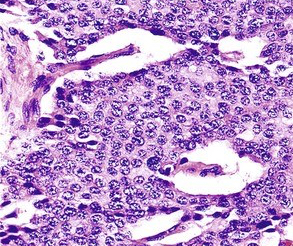
Well, I had to have a picture….These are what a typical neuroendocrine tumor looks like on a cellular level.

night and early morning hours undergoing a battery of blood tests and scans.  A CT scan revealed a soft-tissue mass on my mesentery. In case you didn’t know, the mesentery is the connective tissue that keeps your intestines from falling into a tangled pile around your ass hole.  I was given two rounds of morphine, which resolved the pain. A needle biopsy was scheduled, then delayed then scheduled again and finally happened on April 30.  The final results took another 2 weeks, but it was confirmed that the tumor was a neuroendocrine tumor, which on the realm of good news/bad news is closer to the good news end.

In order to determine if the cancer has spread, I went to Bangkok and was injected with radioactive gallium 68 and had a fancy PET/CT scan.  The injection arrived in a huge lead box, and the hypodermic was shielded by a large lead cylinder.  Yikes!  The scan showed a possible small tumor in a lymph node near my neck and my prostate lit up on the scan suggesting either a tumor there or prostatitis.  This means that the tumor had metastasized.

A bit about this kind of rare tumor.  They normally grow very slowly as mine is (good) but metastasize easily (bad). The location of the tumor on my mesentery is almost 100% likely to be a metastatic tumor, not the original tumor.  In many cases (like mine), the original tumor is never found.  For now, the treatment I have been prescribed is designed to control the growth and spread of the cancer (although there is a 10% chance the treatment will shrink the tumor).  If completely removing the cancer by resection is not possible, then there is quite simply no cure, only control.  Fortunately, several lines of treatment are now available to control these tumors, and many patients live a long time.  So I apparently have incurable but NOT terminal cancer.  The goal is to control it so well that something else gets me first.

On July 5, I had my first injection of sandostatin LAR, a synthetic hormone that attaches itself to neuroendocrine tumors and inhibits their tendency to grow and metastasize.  These injections are not chemotherapy (chemo only works on fast growing cancer).  The side effects are not fun, but nowhere near as bad as having chemo.  I will have 2 more injections 28 days apart followed by another radioactive PET scan in Bangkok.  I am also in the process of obtaining an online second opinion through the MyConsult program at the Cleveland Clinic.

So that’s where I stand for now.  Other then the side-effect of digestive problems, I feel pretty good.  As soon as I can wander farther that 50 m from a toilet, I will resume my jogging program – I am even thinking of trying another marathon down the road.  So life goes on, but my perspectives are evolving rapidly.

Fullerton Loop


Friday afternoon I ran the Fullerton Loop trail, an informal concatenation of trails that meanders around the Coyote Hills of Fullerton. The “official” loop is about 11 miles. I started at my house in east Fullerton – so the loop was 18 grueling up-and-down miles. It took me over 3 hours to complete (not including stops to buy Gatorade and to enjoy the view along the way). 

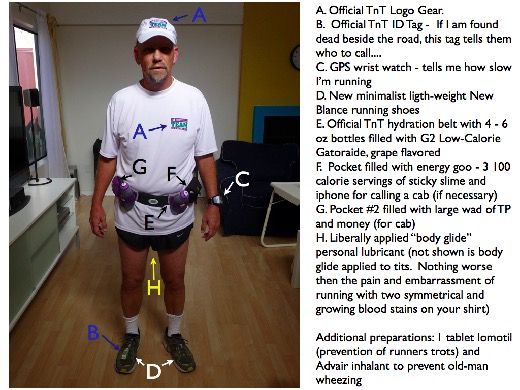
Getting ready for a run like this is not trivial. I have no pit crew – no one will be waiting along the way to hand me a drink or banana – I have to be self sufficient. The photo here shows and explains my critical gear. 

Compared to running the Fullerton Loop solo, the actual marathon will be easy. At the Rock N Roll Marathon there will be drink tables every mile or so, rock bands playing along the route, helpful volunteers standing by with cotton swabs saturated in Vaseline to help with bodily lubrication, port-a-potties galore, and all manner of emergency medical staff and facilities standing by. I can’t wait!

Originally published on my Team In Training fundraising page in 2011. Archived here from a saved webarchive file.

Heat, Jet Lag, and Cold

Sorry for the long delay between posts here. Its been an epic 3-4 weeks. But first things first….Thanks to all the generous donation we have reached nearly 60% of our goal to raise $5000 to fight blood cancers! The goal is now within sight, but I need your help to reach it. Please forward a link to this page to all you friends and ask them to join our team!

I am now back in California after spending three weeks in Thailand. During the first half of this time I was on a research project in southern Thailand searching for evidence of prehistoric tsunamis. Sounds adventurous, but mostly it consisted of digging trenches in the tropical heat. I did find time for some training runs (see the previous post). One of my last runs in southern Thailand was an epic 12 mile round trip from Kamala Beach up and over a high headland to Pathong Beach on the resort island of Phuket. I left at 7 am, but still that was the hottest I have ever been in my life. I drank nearly 12 oz of fluid per mile and still spent the rest of the day trying to rehydrate. 

Following the field work, I travelled to Chiang Mai in the north of Thailand for some R&R which included daily runs in some unusually cool weather, including my longest run so far – 17 miles. I got a couple of rounds of golf in too. 

The worst part about this trip, as usually, was the homecoming. For some reason, jet lag hits me much, much worse traveling east. I was completely worthless for over a week. To add to the misery, I picked up a UR virus – probably from the nasty recirculated air that I breathed for 15 hours on the return flight. Finally, over the last couple of days, I’ve begun to feel like my body and mind are in the same time zone. I’m looking forward to the next 6 weeks and some hard training! 

Go Team!

Originally published on my Team In Training fundraising page in 2011. Archived here from a saved webarchive file.

Hello from the Land of Smiles!

A quick update from Thailand’s Andaman Coast. But first, I want to give a shout out to my buddies at the Anaheim Golf Association – they voted collectively to make a very generous donation to the LLS! Thanks to them and all of my donors I have surpassed the 50% milestone toward my goal of $5000! 

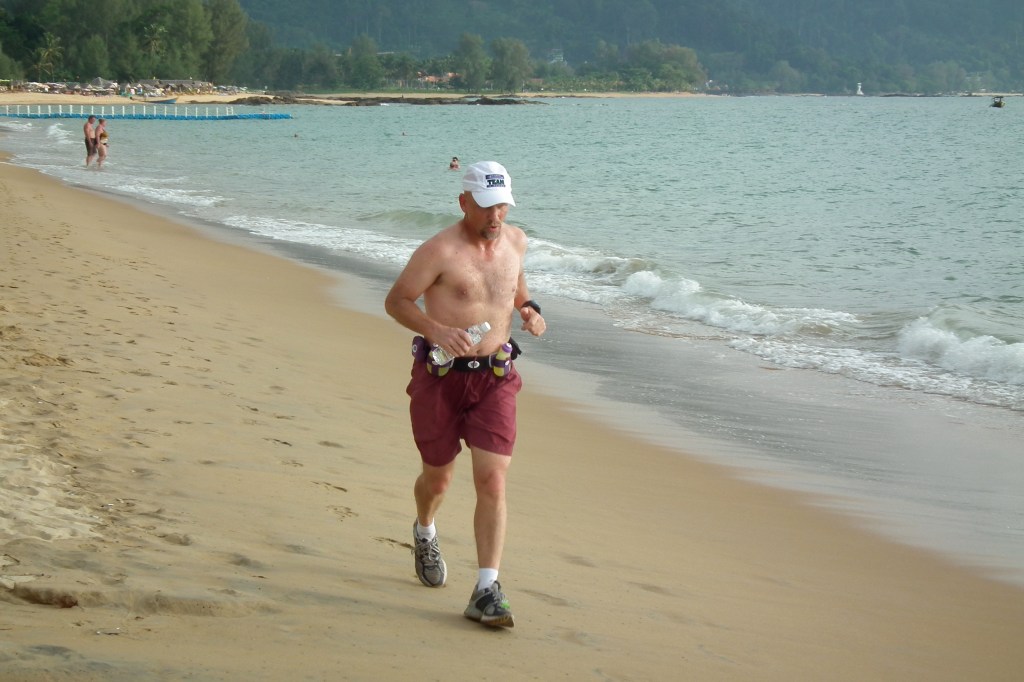
I am now in southern Thailand for field work related to a National Geographic Society sponsored project to study ancient tsunami deposits. Long days in the field, temperatures in the upper 90s (with humidity to match) and some of the most intense rainstorms on the planet have not been conducive to marathon training. I did get in an 8-miler (captured in the photo by one of my co-researchers ) our second day here. The last 4 miles were through a deluge that flooded the streets. Our field work is now over so I should get back to some long runs later this week. 

Go Team!

Originally published on my Team In Training fundraising page in 2011. Archived here from a saved webarchive file.

The Runner’s Malady No One Wants To Talk About

Runners are afflicted with all sorts of injuries, conditions and aches and pains. Shin splints, side stitches, muscle cramps, blisters, bleading nipples, jock rot, Achilles tendonitis, blood in the urine, and soreness in all the moving parts. I’ve suffered most of these, but none of them has really been a show-stopper. Except for one. This malady will be my greatest challenge as I train for, and compete in the 2011 San Diego Marathon.

Warning: If you are squeamish with blunt talk about bodily functions, stop reading and close your browser now!

Runners trots. Seems redundant, but it is aptly named. Running is the best laxative ever invented. I seem to have an especially bad case. Usually within the first mile, but sometime later, or at multiple times in the run, I MUST find a loo. Or bush. Or else. Both of these are in short supply along the most popular running routes in Orange County. I know every gas station, every fast-food outlet, and every possible bush, ravine, or patch of high grass in northern Orange County. Even with my photographic memory of all these spots, sometimes I am caught in-between. Shit. Literally.

Now that I have joined Team in Training, I have started running with my team every Saturday morning. On these runs its worse because I cannot plan on a known point of relief when I need it, and running bowlegged with a load risks significant embarrassment. After two weeks of this, something had to change. Either I was going to become the loneliest long-distance runner, or I was going to lick…errr beat the Runner’s Trots.

First stop Google. I found many remedies – eat this or that, don’t eat this or that, drink coffee before the run, don’t drink anything with caffeine. I quickly got the idea that there was no universally accepted cure. 

I have never been particularly “regular”. My father used to disappear every morning with newspaper in hand, and come out ½ hour later with the day’s job done. I never recall him ever having to go #2 at any other time of day. I tried this. My legs went numb from the sitting, to no avail. The older I get, the worse it becomes. Now that I am training nearly every day, DURING a run is the ONLY time I go. My digestive track seems to shut off accept when I jar it awake during a run.

Finally I had enough – I went to the doctor. He sympathized (and probably snickered to himself when I was gone). He did prescribe some drugs. Lets say one was an “on” drug and one was an “off” drug. I had my first chance to use them this past weekend – so far so good – but we will see about the long term. My Plab B is Depends – do they have a fitness model?

Originally published on my Team In Training fundraising page in 2011. Archived here from a saved webarchive file.

My Mentor

Each new member of Team in Training is assigned a mentor to help guide and motivate you to the finish line. Mentors have run a marathon before with TnT, and they know what it takes. Last week at our first Team in Training workout, I was introduced to my mentor, Carlos de la Feunte. For Carlos, the pain of running a marathon is trivial. Here is the short version of his story in his own words:

“I was introduced to Team in Training in 2006 one year after losing my precious 28 years old daughter Michele to Lymphoma. At the anniversary of Michele’s passing I was still trying to come to grips or make sense of a senseless lost? My heart was broken, but I had the wonderful strong spirit of my beloved Michele that kept me grounded. Michele was the strongest, bravest fighter I had ever met, and I knew that I had to make her proud and help find a way to help other families and patients of blood diseases to find a cure in our lifetime.” 

I need no further motivation.

Originally published on my Team In Training fundraising page in 2011. Archived here from a saved webarchive file.