An item long on my bucket list is to one day see a live penguin in the wild. I’ve seen them in zoos but I’ve never been to the lands they inhabit, at least not during my birding days. You see, penguins are a Southern Hemisphere-only species. They evolved in the cold waters of South America and Antarctica, although they have ventured to the equator at the Galapagos Islands, where the cold Humboldt Current allows them to thrive. The Inhospitably warm tropical waters have prevented them from migrating any farther north.
Years ago, I had a similar life goal: to see a live kangaroo in the wild. I spent a couple of weeks down under cycling along the east coast, from Sydney to Brisbane in search of a live kangaroo. I totally whiffed. I saw several kangaroo carcasses – victims of speeding Aussies, but never a live one. The day before flying out from Brisbane, I visited the Brisbane zoo so at least I could say I saw a live one. Those poor beasts were so fat they couldn’t even hop, although they did manage to drag themselves around in search of free handouts. I am determined not to whiff on a penguin when I get the chance. But wait! There are no penguins in the Northern Hemisphere, but there are the even cuter puffins!
Puffins are not particularly rare, but they breed only on islands of the north Atlantic and live most of their lives out at sea. The remote distribution necessitates a fair bit of effort to see them, unless you’re a Canadian or a Scot. While visiting my son in Manchester ,New Hampshire, I realized that I was probably closer to a puffin than I ever would be, at least in this lifetime. So I negotiated a day of freedom from my wife and son, hopped in my son’s ancient Toyota Corolla, and drove the tollways 3 hours northeast to Boothbay Harbor, Maine. There I boarded a Cap’n Fish’s tour boat and cruised nearly 2 frigid hours east to Eastern Egg Rock, a low seven-acre hunk of schist and quartzite peeping out of the icy North Atlantic. The boat cruised one loop around the island, allowing for about 20 minutes of frantic scanning and photography (made difficult by a 900 mm lens, a pitching boat, and frozen fingers). I saw and shot my puffins, although not as close-up as I would have liked, and then reversed the five-hour journey back to Manchester. Six hours of driving, four hours on a heaving boat, for 20 minutes of birding bliss. Twitching is the act of traveling long distances specifically to see a rare or vagrant bird that has already been located by someone else, with the goal of adding it to a personal checklist. Puffins may not be an endangered species, or rare where I saw them, but I think this qualifies as my most radical twitch to date!
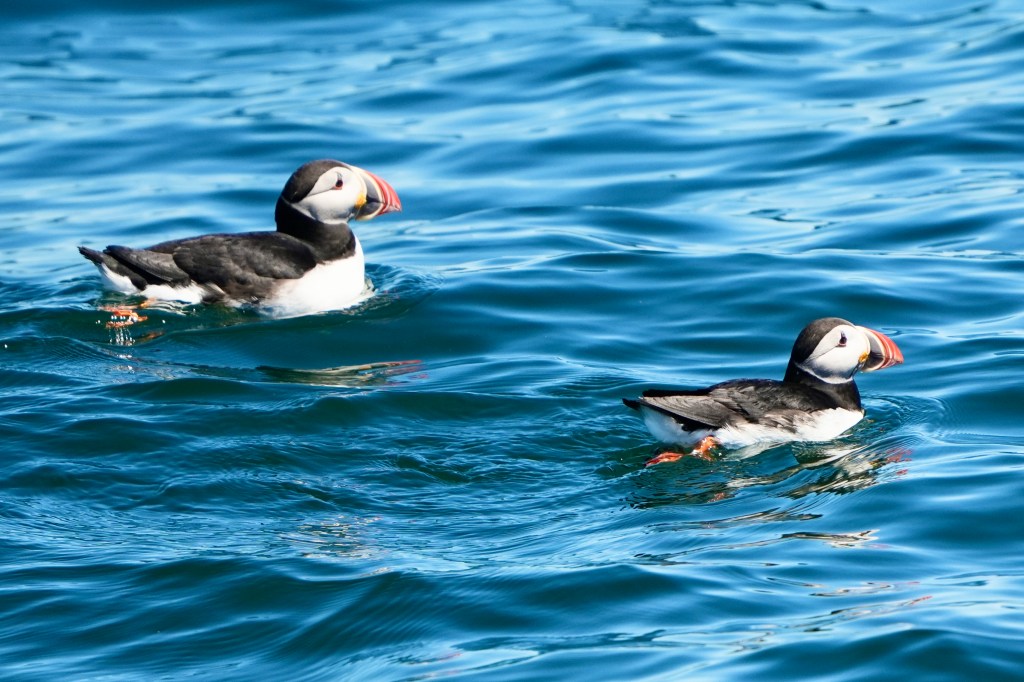
Eastern Egg Rock is both the prehistoric and present-day southern limit of breeding colonies of the Atlantic Puffin (Fratercula arctica). By the end of the 19th century, puffins had been virtually extirpated from Maine coastal islands by hunting for feathers, food and eggs, as well as predation by aggressive gulls. As it turns out, puffins prefer to nest among large colonies of terns. The terns are bigger, are agile aviators, and very aggressively attack any gulls that threaten their territory. But they tolerate the puffins. They are, in effect, the puffins’ bodyguards. Over time, the puffins’ range receded along with the terns’ to only the more remote islands of the far north Atlantic.
Puffins, much like salmon, spend their adolescent years out at sea, never setting foot on dry land. Also, like salmon, after 2-3 years at sea, they return to their birthplace to breed. This behavior means that even with protective laws, they needed help to repopulate their former homes.
In 1974, Dr. Stephen W. Kress of the National Audubon Society, kidnapped some baby puffins from their burrows off the coast of Newfoundland, and placed them in man-made burrows on Eastern Egg Rock. Audubon biologists hand-raised the pufflings until they fledged and flew out to sea. A small number returned a few years later, but they were reluctant to breed on a rock barren of other puffins. To encourage them, scientists placed wooden decoy puffins around the islands, and blasted out recordings of puffin calls (my wife Jane says they sound like water buffalo). By 1981, four pairs of puffins were breeding on Eastern Egg Rock, and the population gradually grew. Today there are over 175 breeding pairs using the small rock every spring. Luckily for the puffins, their bodyguards also made a robust recovery.
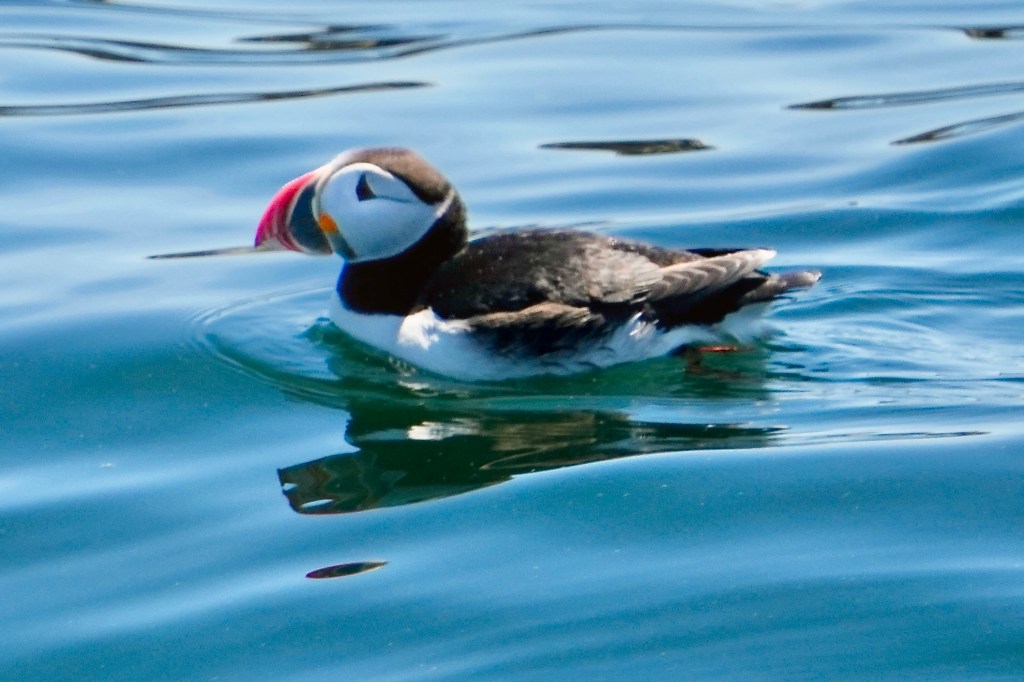
Puffins provide a classic case study in convergent evolution. They look similar to penguins. They can “fly” underwater much like penguins do. Their monochromatic outfit resembles the penguin’s tuxedo. But they are not closely related; penguins and puffins occupy separate branches of the avian family tree. Penguins and puffins independently evolved the same survival tools such as their black and white camouflage, torpedo shape, and the ability to use their wings to swim.
Unlike penguins, puffins retained their ability to fly (although somewhat awkwardly) perhaps because the north Atlantic had more predators than the penguins’ Antarctic homeland. Unlike penguins, puffins evolved a unique serrated beak that enables them to snag several small fish at one go. The bright colors of their beaks during the breeding season likely aid in finding a mate.Puffins were a most worthy twitch. Where should I go now to twitch a wild penguin?

